For vertical SaaS
Your entire market fits in one conference hall. You cannot afford to annoy any of them.
You built software for one industry — property managers, veterinary groups, freight brokers, construction firms. You know their jargon, their software from 2009, the spreadsheet they all secretly run on. The market is not huge, but it is yours to win.
The catch is that it is small and it talks. The operations director you spam today is on a panel with three of your prospects next month. A generic tool treats your market as a list to burn through; in a vertical, the list is finite and every burned name stays burned.
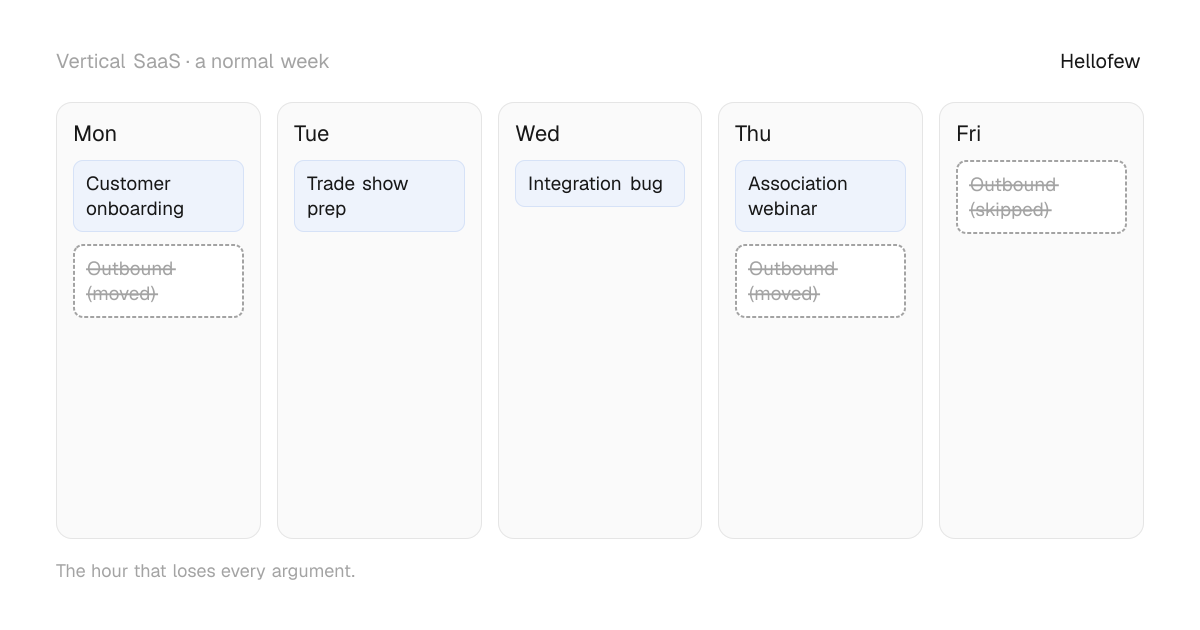
So hand over the hour
Hellofew treats every name as the only one. Paste your product page; agents turn it into the specific titles in your industry, find those people, read their profile and posts, and write one note per person in your market's own language. You approve each one. It sends slowly, from your own account, and a permanent ledger means the same person is never approached twice.
What actually goes wrong
A finite market does not forgive spam
There are perhaps four thousand people in the world who buy what you sell. Burn a few hundred of them with a careless sequence and you have not lost a campaign, you have lost a meaningful slice of the whole market.
What happens instead
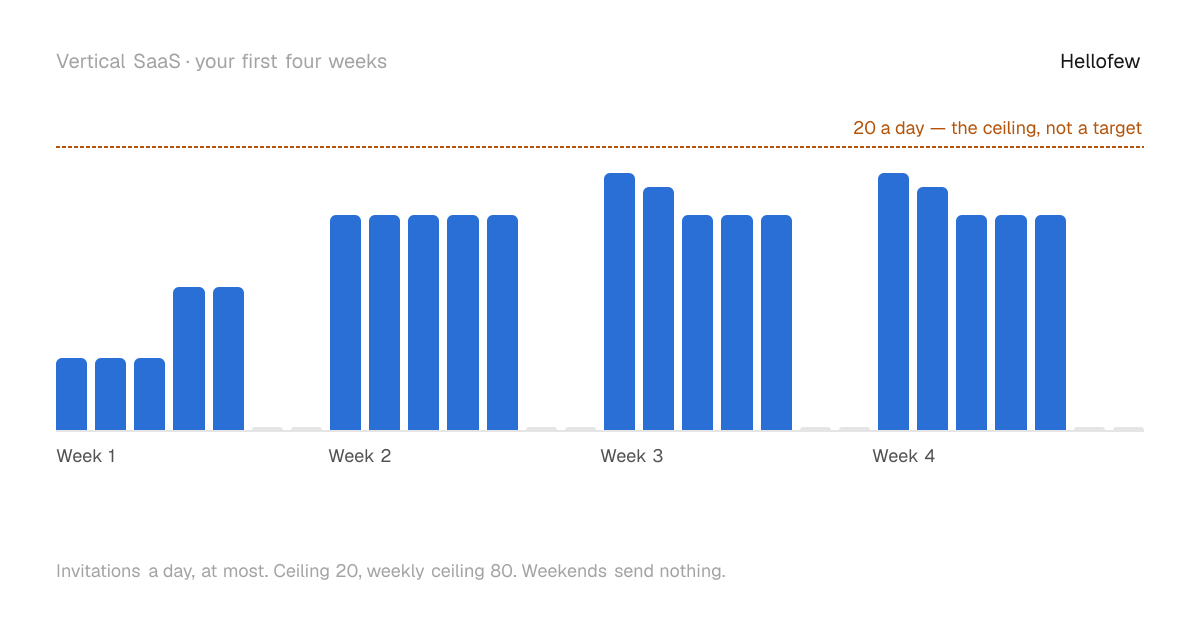
Every approach is recorded in a ledger, so nobody is contacted twice by accident, and anyone who asks to be left alone joins a permanent do-not-contact list. One follow-up, ever. The ceiling of 20 a day is deliberately slow, because in your market speed is the thing that does damage.
Your buyers do not have tech titles
The person who buys your software is a regional operations manager, a practice owner, a head of estimating. Generic outbound tools are tuned for VP of Sales and Head of Growth, and they do not know where to look for yours.
What happens instead
The ICP is written from your page, in your market's terms: five to eight exact titles, which you can edit. Every person found arrives with the reason they were picked and a fit score you can take apart, so you can see immediately if the search has wandered outside your industry.
Industry people can tell an outsider in one line
A note that says "streamline your workflows" to a fleet manager gets deleted. A note that mentions the Monday dispatch scramble gets read. Knowing the industry is your whole advantage, and templated outreach throws it away.
What happens instead
Each note is written from that person's profile and recent posts, plus the angles drawn from your page. If they posted about a specific headache, the note speaks to it, and any quoted phrase is checked against their own words before you ever see it.
Everyone knows the founder
In a vertical, your personal profile is your brand. You speak at the trade show, you are in the association's group. If that account gets restricted, you have lost the channel your whole industry knows you by.
What happens instead
Nothing sends from an account under 150 connections, sending stays inside working hours at irregular gaps, and a falling acceptance rate halves your caps and then stops inviting. Nobody can promise LinkedIn will not restrict an account — the limits here are published so you can judge them.
What your morning looks like instead
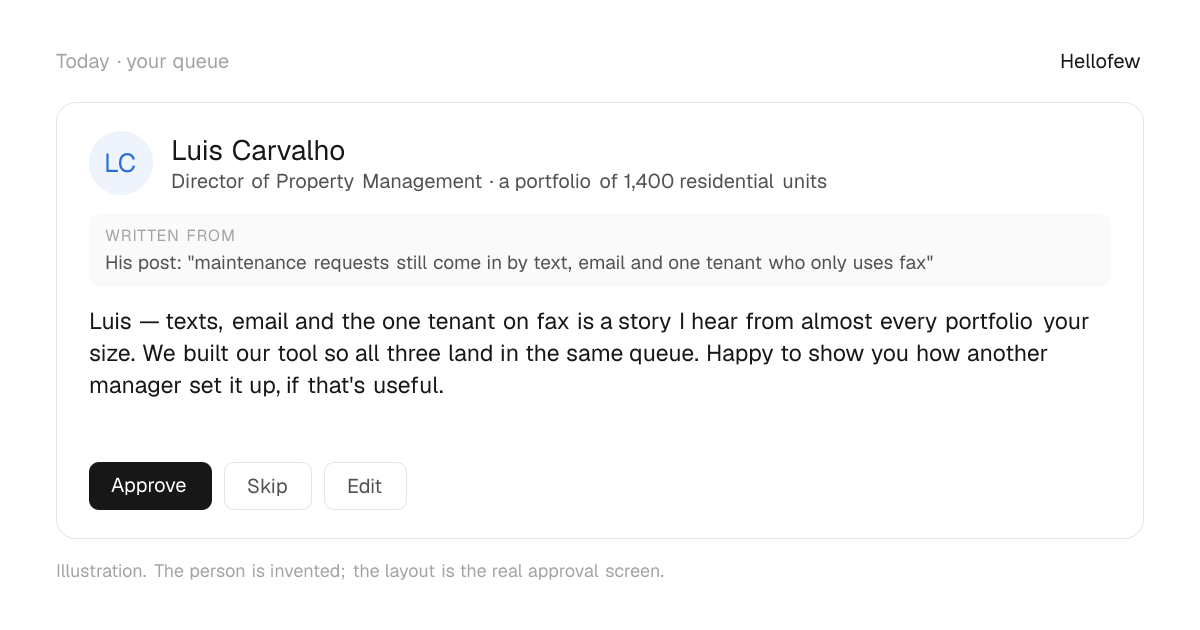
One card per person. Who they are, what the message was written from, and the message itself — so you can judge it in the three seconds you actually have. Approve, skip, or edit. Nothing goes out under your name that you have not read.
Who the agents would go looking for
Typical titles for this kind of buyer. Yours are written from your own page, and you edit them.
- Regional Operations Manager
- Practice Owner
- Director of Property Management
- Head of Estimating
- Fleet Operations Manager
- Owner
Your first month
- 1
Paste your product page and read the ICP — free, no card. Check that the titles are the ones your industry actually uses; edit any that sound like a tech company wrote them.
- 2
Subscribe at $49/month and connect your LinkedIn. About a minute later, up to 25 people from your market, each with the reason they were picked and a note written for them.
- 3
Approve three and sending starts: 5 invitations a day, building over three weeks to 20, weekdays only, skipping public holidays where you are.
- 4
One message and at most one follow-up per person. Replies arrive in one inbox and cancel anything queued. Monday's digest says who replied, and why if nobody did.
Who this is wrong for
If your buyers are not on LinkedIn — many owner-operated trades are not — this cannot reach them, and you will see that fast in a thin queue. If you sell to consumers inside the industry rather than the businesses, it is the wrong channel. And if you want to reach the whole market in a month, it will not: that is exactly what the daily ceiling prevents.
Questions
My market is small. Will it run out of people?
It might, eventually, and that is the honest version. A small market reached slowly and carefully is still a market; one reached in a month with a blunt sequence is not. The daily ceiling of 20 is what makes it last.
Can it avoid our existing customers?
Skip them in the queue — one click — and they are never contacted. Nothing is sent that you did not approve.
Does it know my industry's jargon?
It learns it from your page and from what each person has written. You can edit the ICP's angles and sample note so the vocabulary is exactly right.
The first step costs nothing: paste your page and read what it writes about your market. If it gets your buyers wrong, you have learned something for free. $49/month when you connect LinkedIn and it starts finding real people.