For recruitment agencies
Every hiring manager you want to work with has blocked three recruiters this week.
You are good at placing people. Your candidates stay, your clients come back. What is hard is winning new clients: the heads of talent and hiring managers who would value you are buried in agency outreach, most of it identical, most of it sent in bulk.
And the usual tools make it worse. They are built for sourcing candidates at volume, so they push business development at volume too — the same note to every VP of Engineering in the city. The hiring manager learns to ignore anything that starts with "I specialise in…", and your account starts to look like every other recruiter's.
So hand over the hour
Hellofew is for the business-development side only — finding clients, not candidates. Paste your agency's site or a sector page; agents turn it into the titles that hire through agencies like yours, find those people, read their profile and hiring posts, and write one note per person. You approve each one. It sends from your own account, slowly, and stops the moment they reply.
What actually goes wrong
Hiring managers pattern-match agency pitches instantly
"Hi Mark, I noticed you're hiring and I have some excellent candidates…" He has read that sentence forty times this month. He does not open the fortieth.
What happens instead
Each note is written from what the person actually posted — a role they have struggled to fill, a team they are building, a hiring freeze they just lifted. Any quoted phrase is checked against their own words. Drafts too similar to a recent one are thrown away and rewritten.
Recruiter accounts are the ones LinkedIn watches hardest
Recruiters send more invitations than almost anyone on LinkedIn, and recruiter accounts are restricted accordingly. Mixing high-volume sourcing with business development on the same profile is how an agency owner loses both.
What happens instead
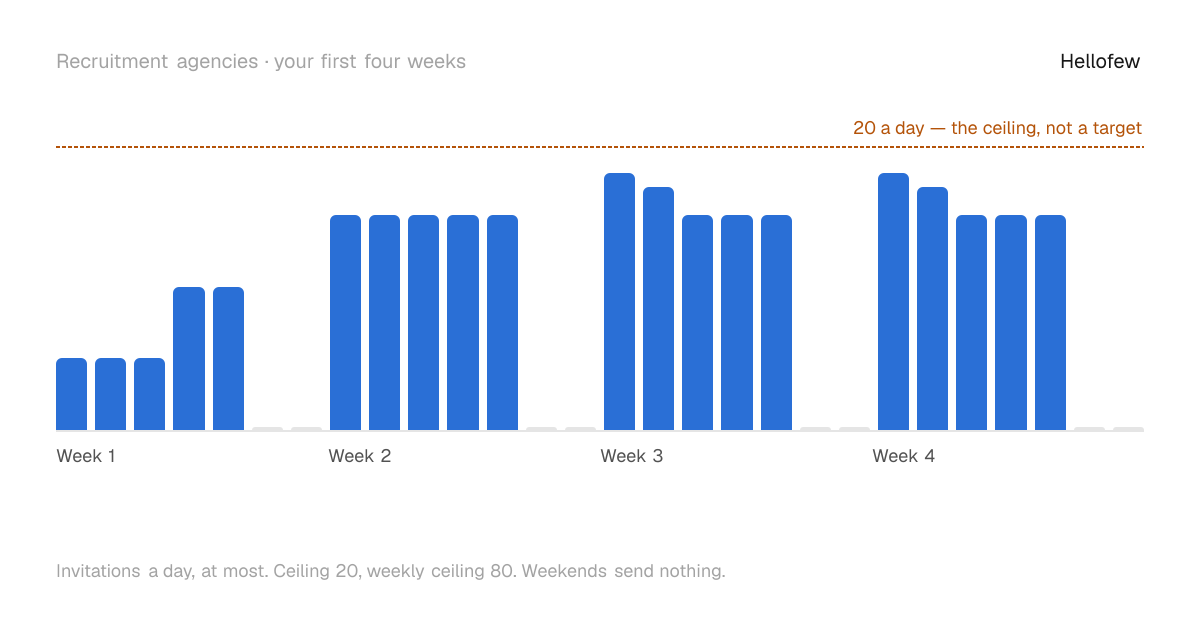
A ceiling of 20 invitations a day and 80 a week, reached over three weeks, with caps that halve on their own if acceptance falls. Critically: running another automation tool on the same account makes every one of these limits meaningless, so the acceptable-use policy forbids it.
Business development loses to the desk every time
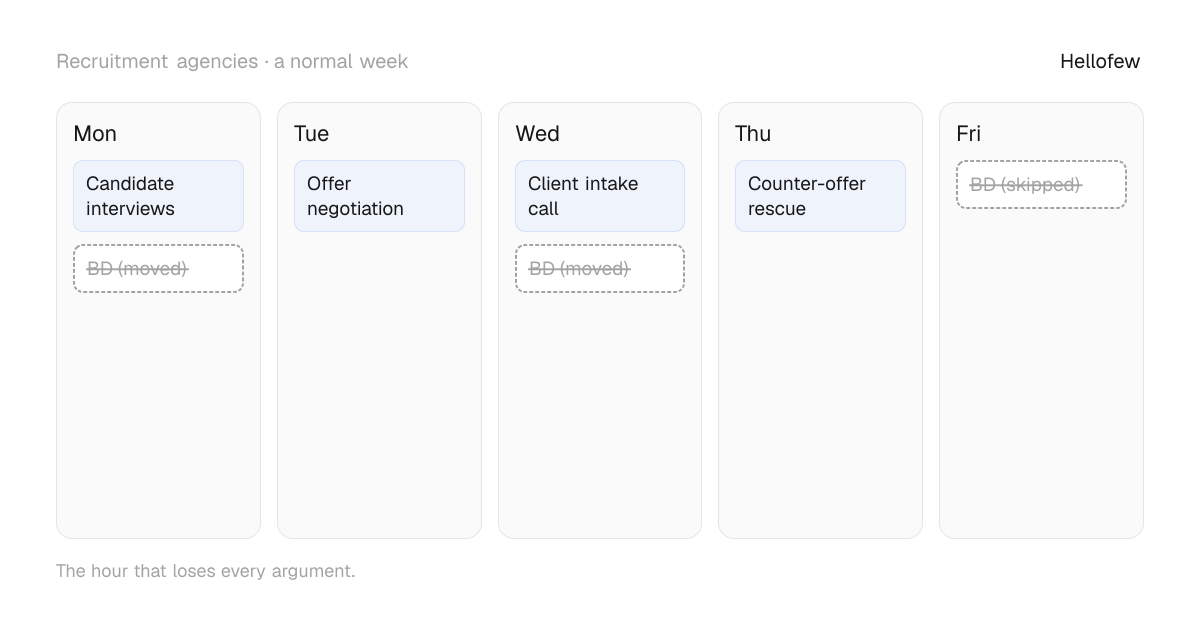
Your day is interviews, offers, a candidate who just got a counter-offer. Client prospecting is what you do when the desk is quiet, which is exactly when you are already short on fees.
What happens instead
The agents run every weekday inside your working hours. Up to 25 potential clients a day arrive with the reason they were picked; you approve the ones you like in a minute and go back to the desk.
A reply followed by a chaser loses the client
A head of talent replied "not now, maybe in Q1". Your sequence tool sent her a cheerful bump two days later. That is the last time she replies to you.
What happens instead
Any reply cancels everything still queued for that person, checked twice right up to the moment of sending. There is one follow-up, ever, and anyone who asks not to be contacted is added to a permanent do-not-contact list.
What your morning looks like instead
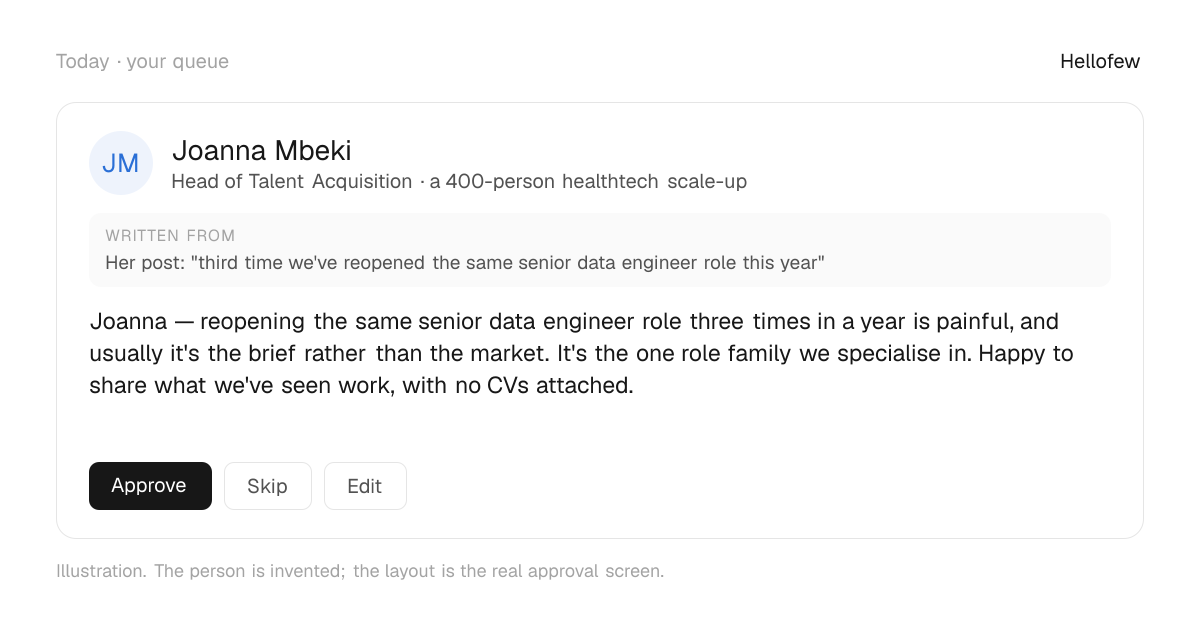
One card per person. Who they are, what the message was written from, and the message itself — so you can judge it in the three seconds you actually have. Approve, skip, or edit. Nothing goes out under your name that you have not read.
Who the agents would go looking for
Typical titles for this kind of buyer. Yours are written from your own page, and you edit them.
- Head of Talent Acquisition
- VP of Engineering
- Head of People
- Talent Partner
- Chief Technology Officer
- Director of Finance
Your first month
- 1
Paste your agency site or your specialist sector page and read the ICP — free, no card. Make sure the titles are the people who hire through agencies, not the candidates you place.
- 2
Subscribe at $49/month and connect your LinkedIn. About a minute later, up to 25 potential clients, each with a note written from their profile and posts.
- 3
Approve three and sending starts: 5 invitations a day, building over three weeks to 20. Stop running any other automation on this account — it breaks every limit here.
- 4
One message per accepted connection and one follow-up at most. Replies land in one inbox, and Monday's digest counts who replied, including on the weeks nobody did.
Who this is wrong for
This is not a candidate-sourcing tool, and using it as one would be the wrong product at the wrong pace — it caps you at 20 invitations a day. If you already run a sourcing automation on your LinkedIn account, you cannot run this alongside it. And if your desk has several consultants each doing their own business development, it covers one account only.
Questions
Can I use it to find candidates?
No. It is built for finding clients: it reads your agency's page and looks for the people who would hire you. Candidate sourcing needs volume this tool deliberately does not have.
I already use LinkedIn Recruiter. Is that a problem?
Running a second automation tool on the same account is prohibited, because we cannot see what the other tool is sending. If Recruiter is used manually, that is not automation — but the safest arrangement is one tool per account.
Will it mention specific candidates?
It writes from your agency's page and the recipient's profile, not from your candidate database. You can edit any note before approving it.
The first step costs nothing: paste your page and read what it writes about your market. If it gets your buyers wrong, you have learned something for free. $49/month when you connect LinkedIn and it starts finding real people.