For development agency owners
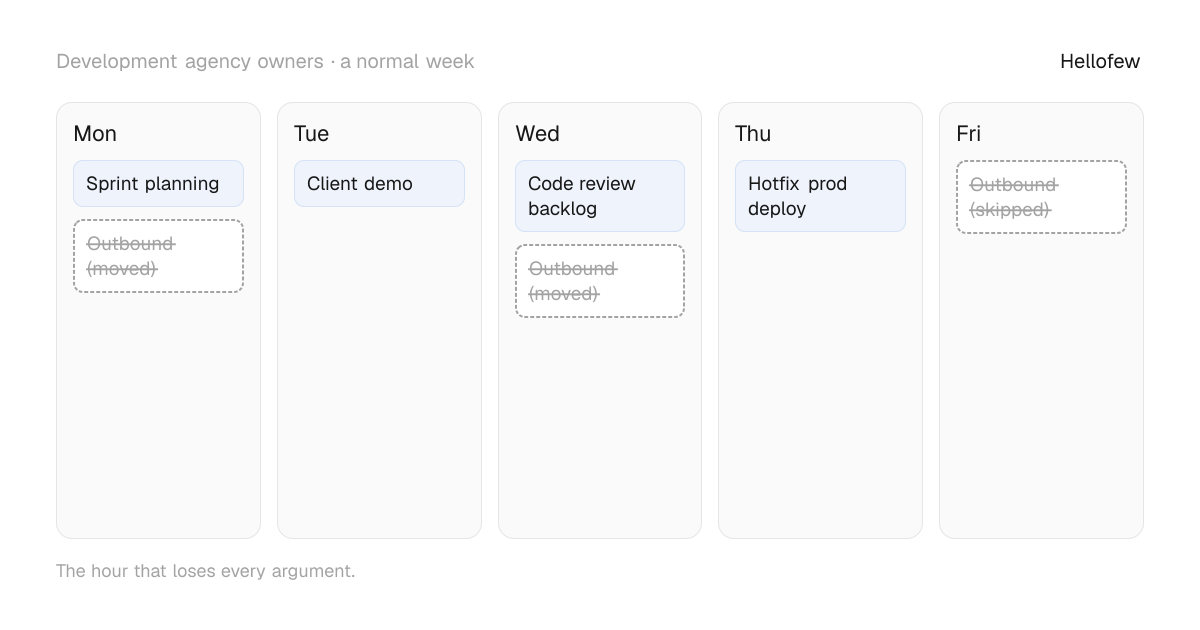
The big project ends in six weeks. Four of your developers have nothing booked after it, and you have been too busy delivering to notice.
You started the agency because you are a good engineer and people kept asking you to build things. Now there are eight of you, the work is good, and the clients who have worked with you would hire you again tomorrow.
But the pipeline is feast and famine. While a big project is running, you are the lead developer, the account manager and the person who fixes the deploy on Friday night. Nobody is selling. Then it ends, and you are staring at a bench of salaried developers and a list of old clients to email.
Everyone tells you to do outbound. The tools that sell outbound to agencies sell it as volume — hundreds of connection requests to every CTO in the region, the same message about “scaling your engineering team”. You have received those. You delete them.
So hand over the hour
Hellofew runs your outbound steadily instead, from your own account, while you deliver. You paste your services page; agents find CTOs and founders at companies that fit the work you do, read what they post, and write a note that talks about their problem rather than your tech stack. You approve each one in the morning, before stand-up.
What actually goes wrong
Feast and famine is a pipeline problem you only notice at the famine
Selling stops the week a big contract starts, because you are needed on it. The next time you look up, the contract is ending and there is nothing behind it. It has happened three times and you have promised yourself it will not happen again.
What happens instead
The agents work every weekday regardless of how busy delivery is. Your only job is a minute of approving, so the pipeline keeps moving through the months you would otherwise have stopped selling.
CTOs get more agency pitches than anyone on LinkedIn
“We are a team of passionate developers helping companies scale.” A CTO receives that sentence daily, from agencies around the world, with a portfolio link. There is nothing in it for them to answer.
What happens instead
Each note is written from the person’s own profile and recent posts. If they wrote about a legacy system, a hiring freeze or a missed deadline, the note speaks to that — with any quote checked against their actual words. A draft too close to a recent one is discarded and rewritten.
Your profile is the agency’s credibility
Prospects check the founder before they check the website. An owner’s account that gets restricted halfway through a pitch cycle takes the agency’s main sales channel with it.
What happens instead
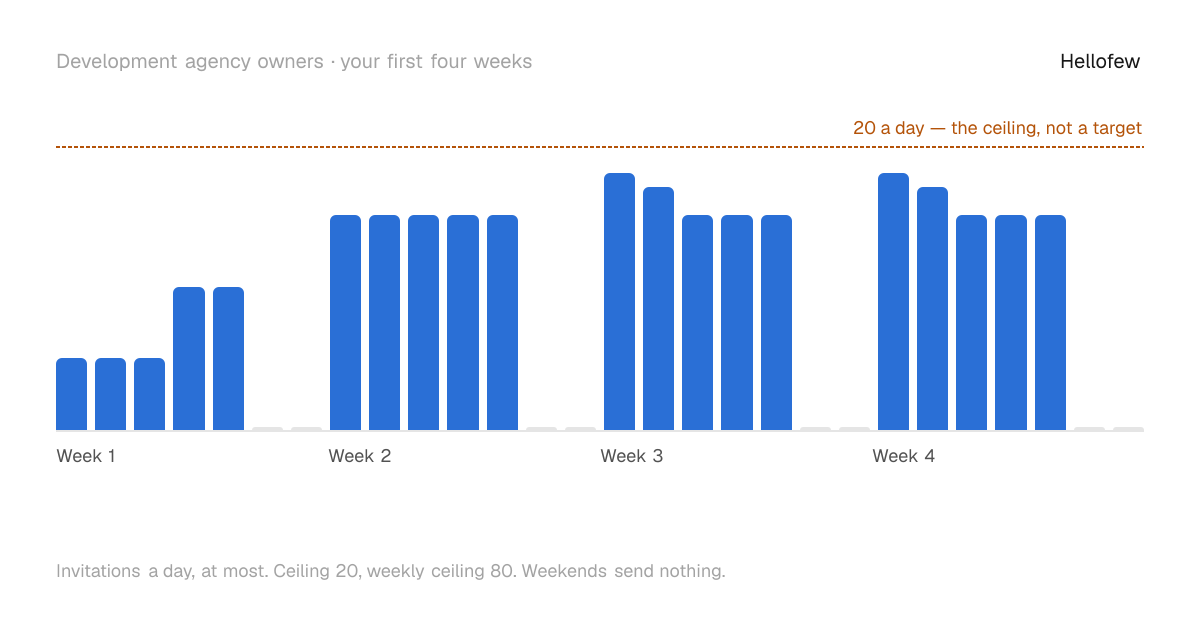
Nothing sends from an account with fewer than 150 connections. A new account starts at 5 a day and never exceeds 20; if acceptance falls, the cap halves, and if it keeps falling, inviting stops and you are told. Every limit is published. It is materially safer than the category, not immune.
One follow-up too many and you are the agency that spammed them
A sequence tool would chase a CTO four times over a fortnight. The fourth message is the one they screenshot and post as an example of what not to do.
What happens instead
One follow-up, ever, and any reply — even “not now” — cancels everything else queued for that person, checked twice right up to the send. Anyone who asks not to be contacted is on a permanent list.
What your morning looks like instead
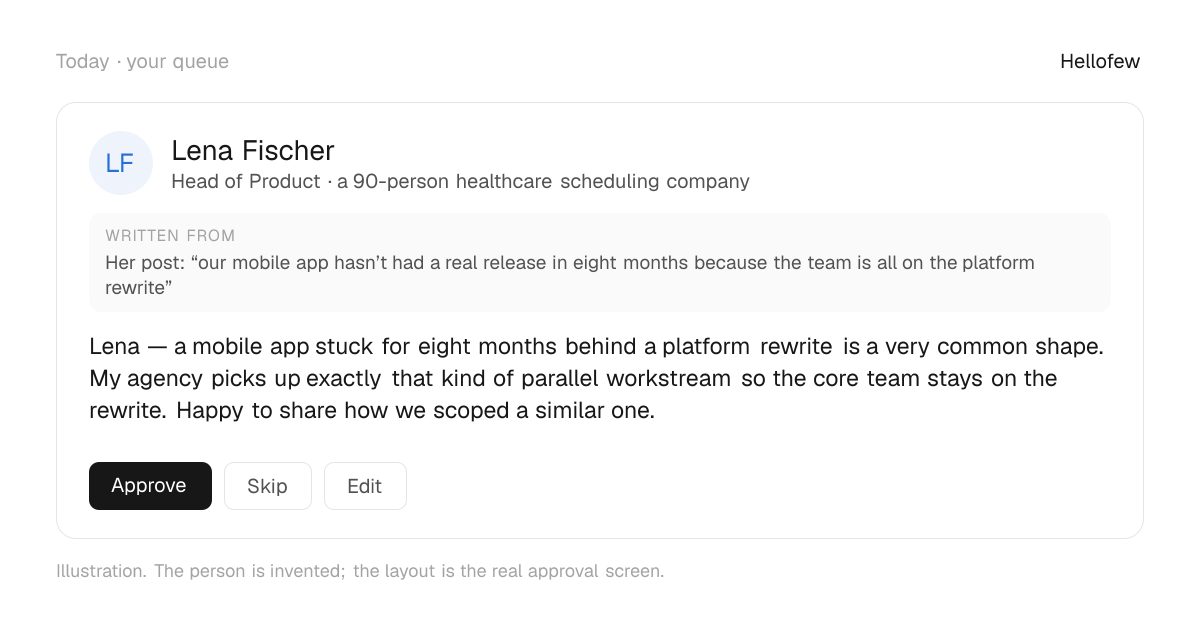
One card per person. Who they are, what the message was written from, and the message itself — so you can judge it in the three seconds you actually have. Approve, skip, or edit. Nothing goes out under your name that you have not read.
Who the agents would go looking for
Typical titles for this kind of buyer. Yours are written from your own page, and you edit them.
- CTO
- VP of Engineering
- Head of Product
- Founder & CEO
- Director of Digital
- Head of Engineering
Your first month
- 1
Paste your services page — free, no card. Tighten the ICP to the size and kind of company you do your best work for, not everyone who might need software.
- 2
Subscribe at $49/month and connect your own LinkedIn. About a minute later there are up to 25 people in the queue, each with a reason and a note.
- 3
Approve three and sending starts at 5 a day, climbing over three weeks towards 20, only inside your working hours.
- 4
Accepted connections get one message and one follow-up at most. The Monday digest counts replies, so you can see the next quarter’s pipeline forming before the bench does.
Who this is wrong for
If you have a business development team, each with their own account, you need seats and a CRM sync; this runs one account for one person. If your work comes through platforms or tenders, cold notes are the wrong route. And if you want to reach every CTO in a country this quarter, buy a volume tool — this caps you at 20 a day on purpose.
Questions
Can my business development person use it on their account?
It runs one LinkedIn account, connected by the person who owns it. If that person is your BD lead rather than you, it works the same; it is just one account per workspace.
Can it attach case studies?
The notes are short and written for one person. You can put your strongest proof points in the positioning and angles, and the drafter uses them where they fit the recipient.
Does it sync to our CRM?
No. Replies land in its own inbox. If your agency lives in a CRM with a sales process around it, that is a reason to choose a larger tool.
The first step costs nothing: paste your page and read what it writes about your market. If it gets your buyers wrong, you have learned something for free. $49/month when you connect LinkedIn and it starts finding real people.