For developer tools
Your GitHub stars are going up. None of the people with a budget have heard of you.
Developers found your tool on their own. They starred the repo, left a thoughtful issue, maybe wired it into a side project. Then the conversation stalls, because the person who can put it on an invoice — the engineering manager, the platform lead, the VP who owns the build pipeline — has never seen it.
You know outbound to engineers is a minefield. They can smell a sequence from the first line, and they talk. One smarmy "quick question about your dev workflow" gets screenshotted into a group chat and your tool becomes the one that spams. So you do nothing, and wait for bottom-up adoption to climb a ladder it rarely climbs on its own.
So hand over the hour
Hellofew writes to the people above the developers, one at a time, from what they have actually said. You paste your docs or landing page; agents turn it into the titles that own the budget, find those people, read their profile and recent posts, and draft a note that sounds like one engineer writing to another. You read every one before it goes. It sends from your account and stops the moment they answer.
What actually goes wrong
Bottom-up adoption stops one floor below the budget
Forty engineers at a company use your free tier. Nobody there has ever talked to you. When procurement finally asks "what is this and why are we paying nothing for it", the answer is a shrug, and the easiest move is to rip it out.
What happens instead
The ICP it writes aims above the user: the platform lead, the engineering manager, the head of developer experience. Each one arrives with a fit score you can take apart and the reason they were picked, so you are writing to the person who can say yes, not the person who already did.
Engineers punish anything that reads like a template
A technical buyer reads "I noticed you're the Staff Engineer at Acme" and knows two things at once: nobody looked, and the next four messages are already scheduled. They block, and some of them post the screenshot.
What happens instead
Nothing is written until their profile and recent posts have been read. If they wrote about a flaky CI run or a migration they regret, the note can answer that — and every quoted phrase is checked, character for character, against what they actually wrote. A quote that cannot be found is stripped and flagged to you before you approve.
A follow-up sequence is the fastest way to become a meme
Your worst nightmare is a thread titled "this devtool emailed me six times". Most outbound tools make that easy: bump, bump, breakup email. With a developer audience, the third message costs you more than the first one earned.
What happens instead
There is one follow-up, ever, and no setting to add a second. Any reply — including "not interested" — cancels everything still queued for that person, and that is checked twice, right up to the moment of sending. Anyone who asks not to be contacted goes on a permanent do-not-contact list.
You are the founder, the maintainer and the support desk
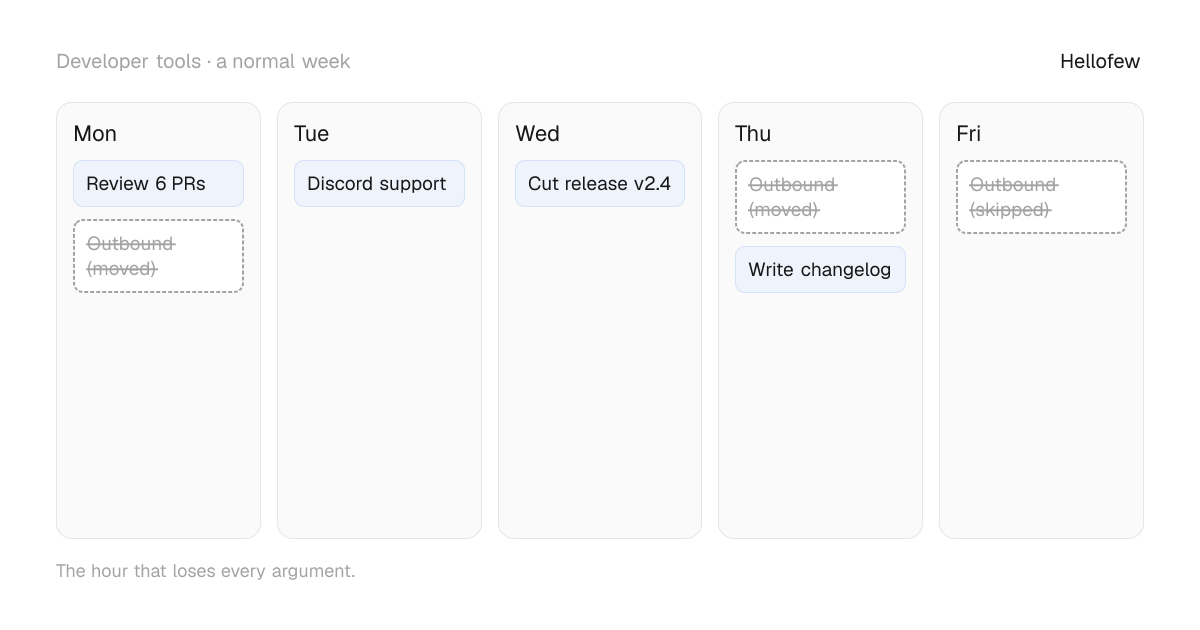
Between reviewing pull requests, answering Discord and writing the changelog, the hour for outbound never arrives. When it does, it is a Friday-night burst from an account that has been quiet for a month.
What happens instead
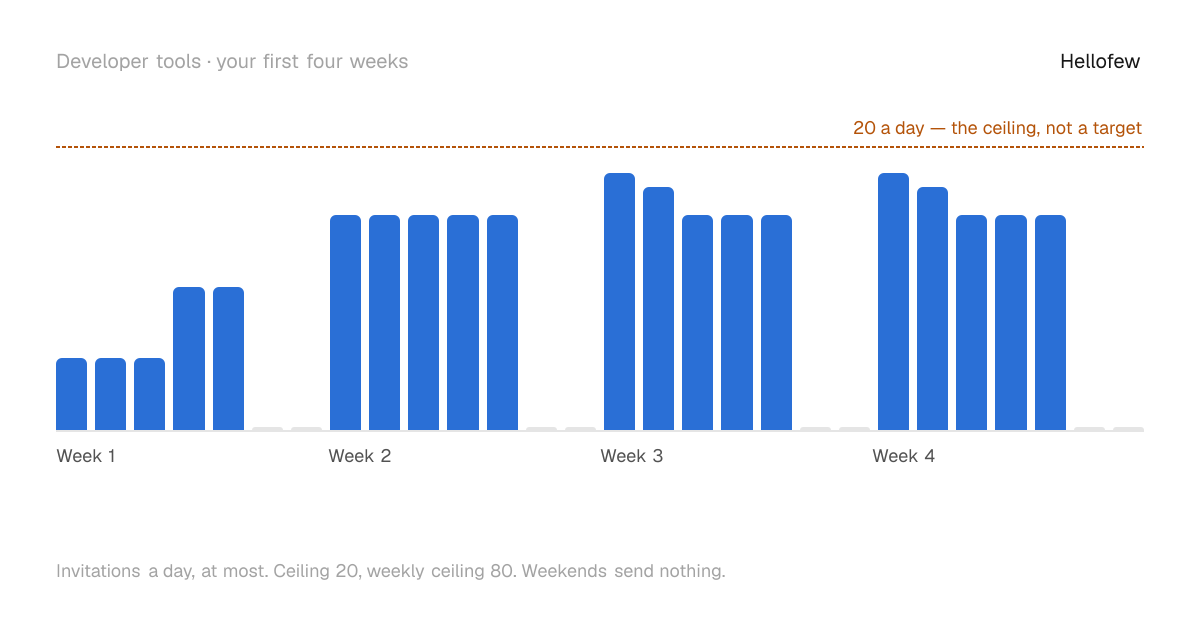
The agents run every weekday, inside your working hours, at irregular gaps. A new account starts at 5 invitations a day and climbs over three weeks to a ceiling of 20. Your part is a minute of reading in the morning, and approving three is what starts it.
What your morning looks like instead
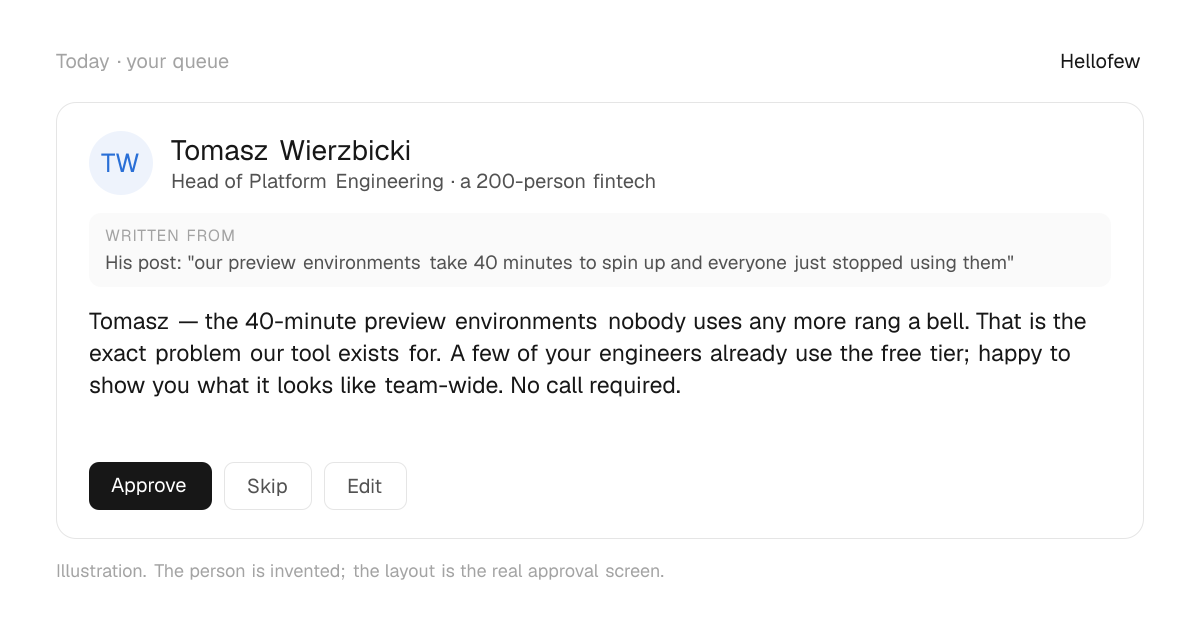
One card per person. Who they are, what the message was written from, and the message itself — so you can judge it in the three seconds you actually have. Approve, skip, or edit. Nothing goes out under your name that you have not read.
Who the agents would go looking for
Typical titles for this kind of buyer. Yours are written from your own page, and you edit them.
- Engineering Manager
- Head of Platform Engineering
- Director of Developer Experience
- VP of Engineering
- Staff Software Engineer
- CTO
Your first month
- 1
Paste your docs or landing page and read the ICP it writes — free, no card. If it aims at the developers who already use you rather than the people who buy for them, edit the titles.
- 2
Subscribe at $49/month and connect LinkedIn on LinkedIn's own sign-in page. About a minute later, up to 25 engineering leaders, each with the reason they were picked and a note written from their own profile.
- 3
Approve three and sending starts: 5 a day at first, rising over three weeks towards 20, weekdays only, never at the edges of your working day. Skip anyone who would recognise you from your repo and prefer a direct message.
- 4
Those who accept get one message and, if they stay quiet, one follow-up. Replies land in one inbox. Monday's digest counts who replied — and on a quiet week, says why.
Who this is wrong for
If your tool is a free CLI with no paid tier, there is nobody to sell to yet and this will not help. If your buyers are individual developers paying with a personal card, LinkedIn outbound is the wrong channel — they are not reading it. And if you want to message every engineer at a target company at once, this will not do it: it caps you at 20 invitations a day, deliberately.
Questions
Will it message my existing open-source users?
It looks for people by title and profile, not from your GitHub data. If someone you already know turns up in the queue, skip them — skipping is one click, and nothing sends that you did not approve.
Can the notes be technical?
They are written from what the person actually posted and from your own page. If your page is technical, the angles will be. You can edit the ICP's three angles and the sample note so the voice is yours.
Does it do email too? Developers read email more.
No. It is LinkedIn only, from one account. If email is your main channel, a dedicated email tool will serve you better.
The first step costs nothing: paste your page and read what it writes about your market. If it gets your buyers wrong, you have learned something for free. $49/month when you connect LinkedIn and it starts finding real people.