For technical founders of AI startups
Your model beats the benchmark. Your buyer deleted forty messages this week that said the same thing.
You built something that genuinely works. Not a wrapper — you fine-tuned it, you evaluated it, you know its failure cases better than anyone. It saves the right kind of team hours a week, and you can prove it on their own data.
The problem is that every Head of Operations on LinkedIn now receives the same message several times a day: an AI company, a vague promise about agents, a meeting link. They have learned to delete anything that contains the word “AI” in the first line. Your message, which is true, looks exactly like the thirty that are not.
The obvious answer in your world is to automate outreach with a model. You also know precisely how that goes: fluent, confident, generic, and occasionally quoting a prospect saying something they never said. You would not ship that to a customer, and you should not ship it to a prospect.
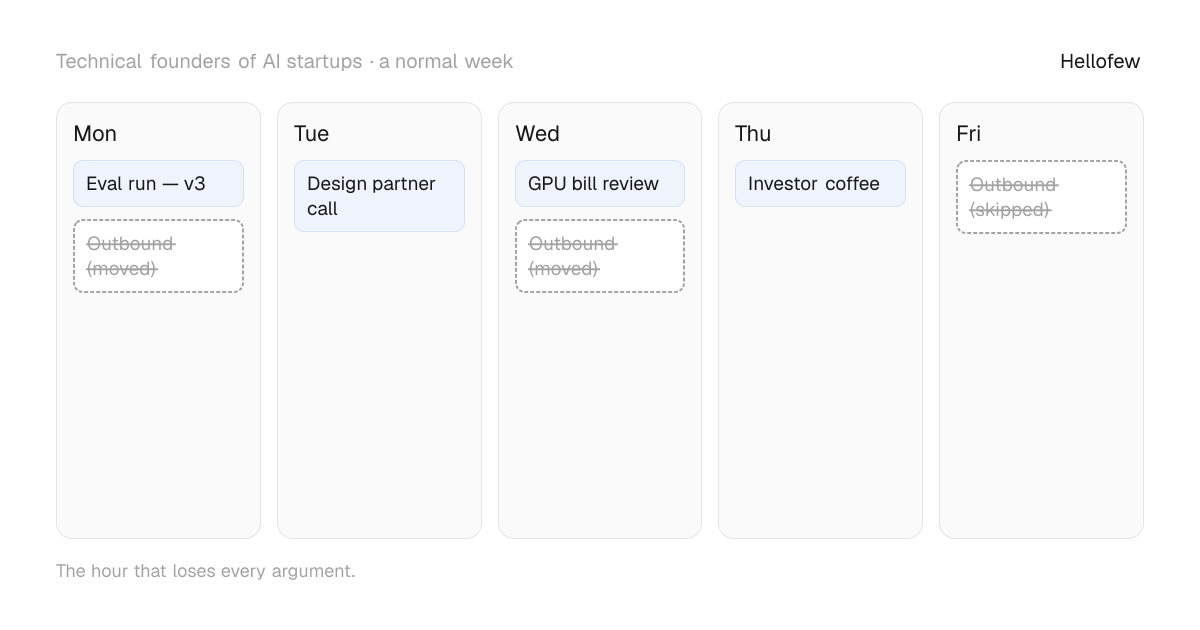
So hand over the hour
Hellofew is that automation built by someone who worried about the same things. Agents read each person’s profile and recent posts before writing, every quoted phrase is checked verbatim against what they actually wrote, and nothing leaves your account until you have read it and approved it.
What actually goes wrong
Your category has trained buyers to ignore you
“Revolutionise your workflow with AI agents.” Your buyer has read that sentence so many times it has become invisible. Anything that opens with the technology gets filed with the rest, however good the technology is.
What happens instead
The ICP and the angles are written from the buyer’s problem, not your stack. Each note opens on something the person said or does, and the draft that reads like the other thirty is the one that gets discarded and regenerated when it is too close to a recent message.
You know how models hallucinate, and so does your prospect
The fastest way to lose a technical buyer is a cold message that quotes them saying something they never said. It is fluent, plausible and wrong, and only one person on earth can detect it — the person you most wanted to impress.
What happens instead
Quotes are checked with a string comparison, not a second model call: every quoted span must appear verbatim in what they actually wrote, after normalising case and punctuation. If it does not, the draft is regenerated once; if it still does not, the quotation marks are stripped and the problem is flagged to you. Reposts are excluded, so it never praises someone for words they merely shared.
Your time is worth more on the model than on the pipeline
An afternoon of outreach is an afternoon not spent on the eval that decides whether the next customer renews. Every hour you spend writing to strangers is an hour of the thing only you can do.
What happens instead
Your part is reviewing the queue: approve, skip, edit. The research and writing happen before you look. Approving three is what starts sending, and there is no campaign builder to learn.
Early-stage AI startups get judged by the founder’s profile
Investors, candidates and design partners all look at your LinkedIn. An account restricted halfway through a raise is not a sales problem; it is a credibility problem you would have to explain.
What happens instead
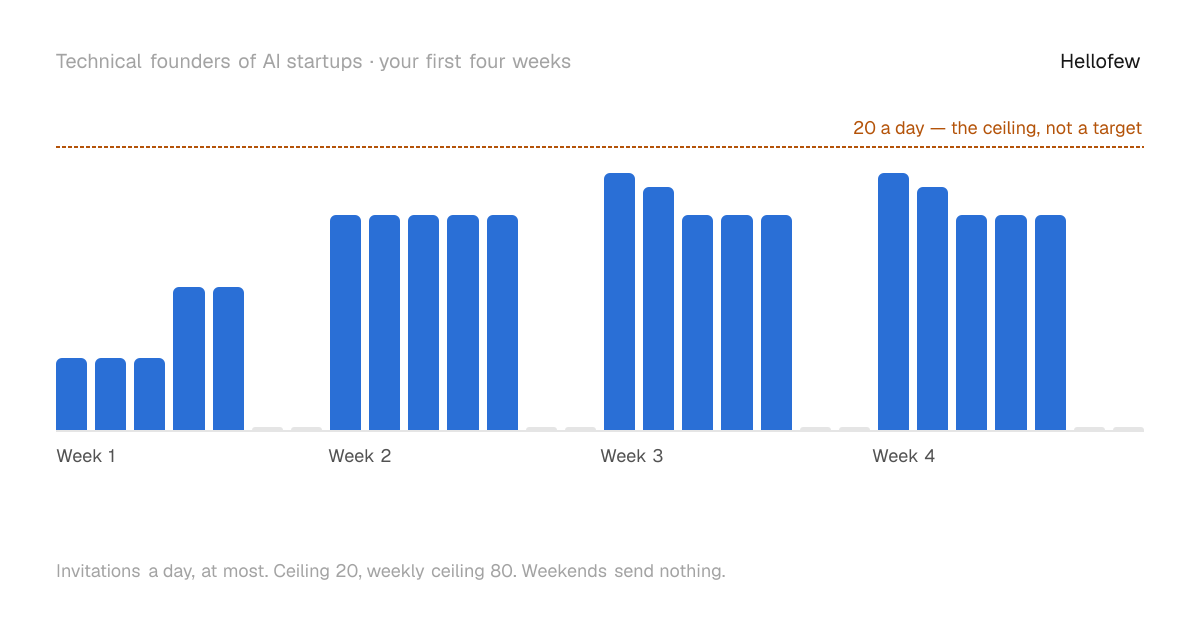
An account under 150 connections sends nothing at all. The ramp starts at 5 a day and never exceeds 20; acceptance is watched from day four, and a LinkedIn flag in the first day stops the account until you restart it yourself. Materially safer than the category, with every limit published — but not a promise that nothing can happen.
What your morning looks like instead
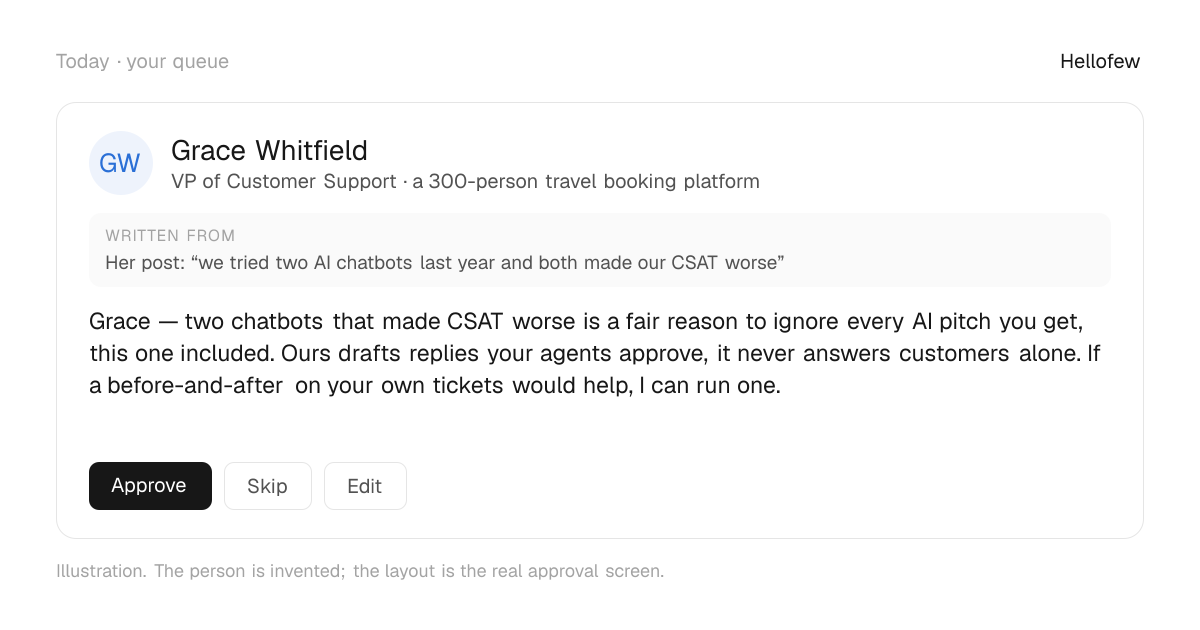
One card per person. Who they are, what the message was written from, and the message itself — so you can judge it in the three seconds you actually have. Approve, skip, or edit. Nothing goes out under your name that you have not read.
Who the agents would go looking for
Typical titles for this kind of buyer. Yours are written from your own page, and you edit them.
- Head of Operations
- VP of Customer Support
- Director of Claims
- Head of Legal Operations
- Chief Operating Officer
- Director of Data
Your first month
- 1
Paste your product page — free, no card — and check the angles it writes. If any lead with the technology, rewrite them around the outcome; that one edit shapes every note that follows.
- 2
Subscribe at $49/month and connect LinkedIn. About a minute later, a queue of up to 25 people, each with what the note was written from shown underneath it.
- 3
Approve three and sending starts at 5 a day, rising over three weeks to 20. Read the evidence line on each draft — it is how you know nothing was made up.
- 4
Accepted connections get one message and one follow-up at most. The Monday digest reports replies, and when a week is quiet it tells you why rather than dressing it up.
Who this is wrong for
If you sell an API to developers who integrate it themselves, LinkedIn outbound to operations leaders is the wrong motion. If you have a sales team running enterprise pilots with procurement, you need seats and a CRM; this runs one account for one person. And if you want a fully autonomous agent sending without review, this deliberately is not that — approving each message is the design.
Questions
Which model writes the messages?
The research pass and the drafting are given their own, stronger model than the rest of the pipeline, because they are the only part a prospect ever sees. Whichever model it is, nothing reaches the prospect until you have approved it.
Does it mention that the message was drafted by AI?
The message comes from you, from your account, and you have read it before it goes. Whether you mention how you work is your call; the point of approval is that every note is one you would send yourself.
Can it target people who posted about a specific problem?
It finds people by the titles in your ICP, then reads their recent posts. A person whose posts match your angle is scored higher and the note is written from what they said; it does not run keyword searches across all of LinkedIn.
The first step costs nothing: paste your page and read what it writes about your market. If it gets your buyers wrong, you have learned something for free. $49/month when you connect LinkedIn and it starts finding real people.