For solo founders of developer tools
Four hundred GitHub stars, a Discord that answers itself, and not one engineering manager who knows it exists.
The developers found you. They starred the repo, filed the issues, wrote the nice thread about how it saved them a weekend. Some of them use it at work, on a free tier, on a laptop their employer does not know about.
The person who would turn that into a contract is two levels above them. A Head of Platform, a Director of Engineering, a VP who owns the tooling budget and has never visited your docs. They are on LinkedIn, and you are the only person at the company, so you are also the only person who could write to them.
And writing to them is the part of this job you are worst at and least want. Developers smell a sales message from the first word, and you are a developer. Every draft you write sounds either like a README or like the thing you hate receiving.
So hand over the hour
Hellofew finds those buyers and writes to them for you, from your own account. You paste your pricing or product page; agents propose the titles who hold the budget, find them, read what they post, and write one note per person that talks about their team’s problem rather than your feature list. You approve each one before anything sends.
What actually goes wrong
Usage is bottom-up; the budget is top-down
You can see the company domains in your sign-ups. Eleven people from one bank use your tool. The bank has never paid you, because the eleven people are not the person who pays, and none of them is going to go and argue for a line item on your behalf.
What happens instead
The ICP targets the title that signs, not the one that installs. You can steer it — put Head of Platform or Director of Developer Experience in the titles, and the agents look for those people, score them on fit, and tell you why each one was picked.
Developer audiences punish anything that reads like marketing
One cringeworthy message and it is screenshotted in a Slack you are not in. You know the tone engineers trust — specific, short, a little dry — and you also know you will not have time to write it forty times.
What happens instead
Each note is written from the person’s own profile and recent posts, not merged from a template, and a draft too close to a recent one is thrown out and rewritten. If it quotes something they wrote, the quote is checked character for character against the post, and stripped and flagged to you if it cannot be found.
You are the support desk, the release manager and the salesperson
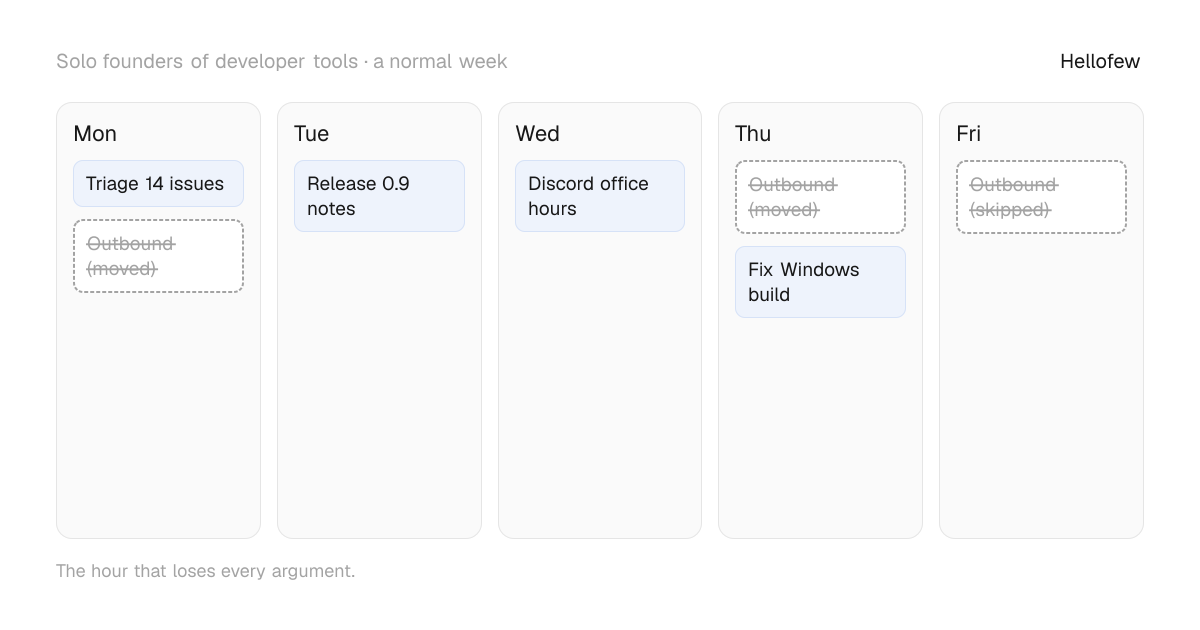
The issue queue is never empty. A release takes a day longer than planned. Outbound is the job with no deadline, so it is the one that slides, every week, for a year.
What happens instead
The agents do the research and writing every weekday regardless. Your part is a minute of approving in the morning, and it starts sending the moment you approve the first three — there is no campaign to set up and no sequence builder.
A blown LinkedIn account is a blown founder brand
For a solo devtools founder, your profile is the company. It is where conference organisers, potential acquirers and your best users find you. Losing it to a sending tool would cost more than any deal it could win.
What happens instead
Nothing sends from an account with fewer than 150 connections. If acceptance falls, the daily cap halves on its own; if it keeps falling, inviting stops and you are told. A blunter check runs from day four, and a LinkedIn flag in the first day of sending stops everything until you restart it yourself. Materially safer than the category — not a guarantee, because nothing is.
What your morning looks like instead
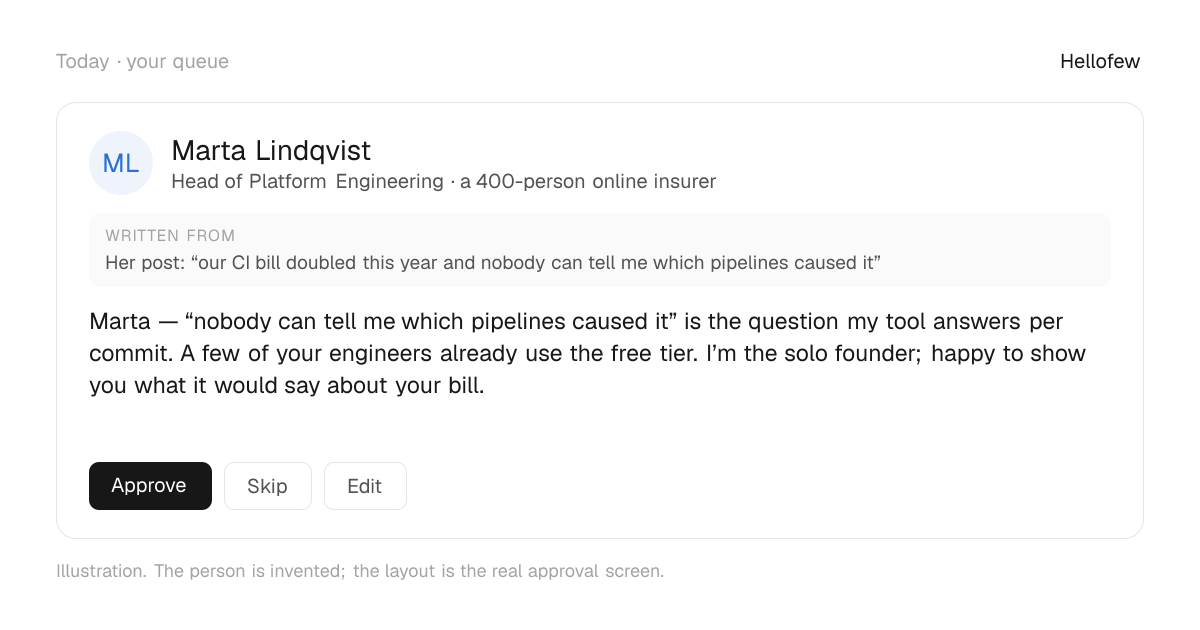
One card per person. Who they are, what the message was written from, and the message itself — so you can judge it in the three seconds you actually have. Approve, skip, or edit. Nothing goes out under your name that you have not read.
Who the agents would go looking for
Typical titles for this kind of buyer. Yours are written from your own page, and you edit them.
- Head of Platform Engineering
- Director of Engineering
- VP of Engineering
- Engineering Manager, Developer Experience
- Head of Infrastructure
- CTO
Your first month
- 1
Paste your pricing or product page — free, no card. Check whether the ICP picked the buyers or the users; for a developer tool it is usually worth moving the titles one level up.
- 2
Subscribe at $49/month and connect LinkedIn. About a minute later there are up to 25 people in the queue, each with a score and the reason they fit.
- 3
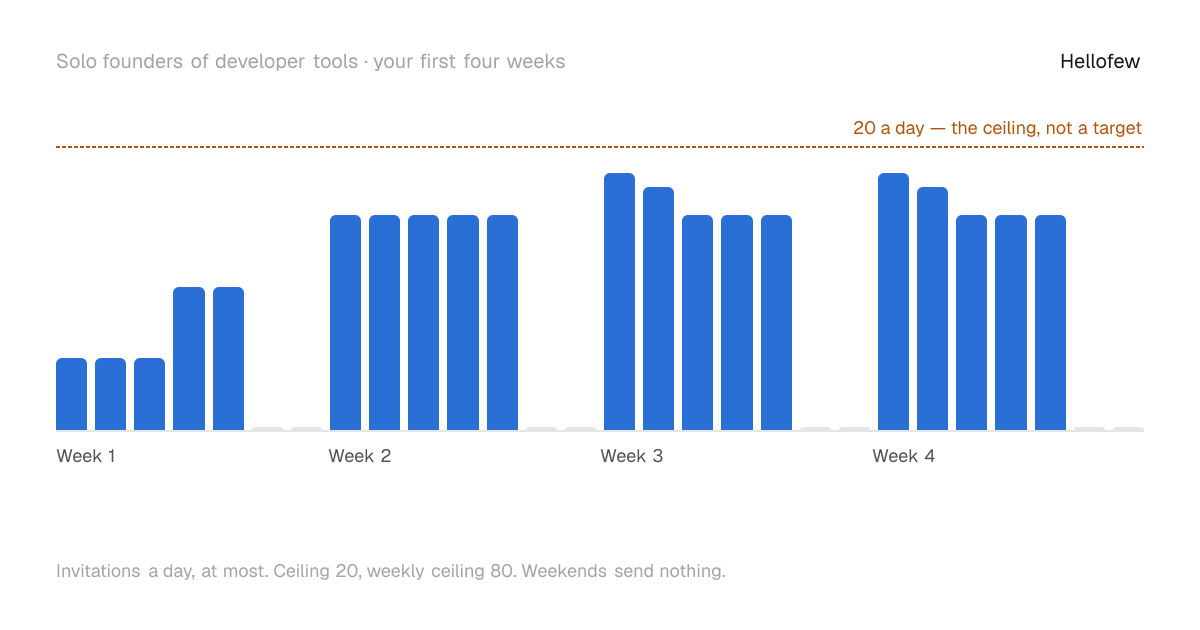
Approve three and it starts: 5 invitations a day at first, rising over three weeks towards 20, weekdays only, skipping public holidays where you live.
- 4
Accepted connections get one message and one follow-up at most, and any reply stops the rest. The Monday digest counts replies — the one number that says whether the targeting is right.
Who this is wrong for
If your buyer genuinely is the individual developer paying with a personal card, LinkedIn is the wrong place to find them and this is the wrong tool. If you are open source with no paid tier yet, there is nothing for a budget holder to buy, so wait. And if you want to announce a launch to everyone at once, that is a post, not outbound.
Questions
Can it use my sign-up data to find the companies already using the tool?
No. It finds people on LinkedIn by title, company and profile. It does not connect to your product analytics. You can shape the ICP around the kinds of companies your users work at.
Will it spam developers in my community?
It writes to the titles in your ICP, and you approve every person before anything goes out. Anyone who asks not to be contacted goes on a permanent do-not-contact list across every customer, and is never messaged again.
What if nobody accepts?
Then you find out quickly and without damage. If acceptance falls, the cap halves; below a floor, inviting stops and the digest says why. A low accept rate is almost always targeting, and it is cheaper to learn that at 5 a day than at a hundred.
The first step costs nothing: paste your page and read what it writes about your market. If it gets your buyers wrong, you have learned something for free. $49/month when you connect LinkedIn and it starts finding real people.