For founding sales hires
You are the first sales hire. There is no SDR team, no playbook, and a pipeline target the founders wrote on a whiteboard.
They hired you to prove that someone other than the founders can sell this. You have a product that is still changing, a market that is still being figured out, and a quota. You also have your own LinkedIn account, which is the one channel that came with you to this job and will come with you to the next one.
The playbook says hire SDRs and buy a sequencing tool. You do not have the SDRs, and the sequencing tools want you to send at a volume that turns your profile into a spam channel — the profile you will still need when this startup becomes a line on it.
So hand over the hour
Hellofew does the prospecting an SDR would, from your account, at a pace you would sign your name to. You paste the product page; agents write the ICP, find matching people, read their profile and posts, and draft one note each. You approve every message. It sends slowly, follows up once, and stops when anyone replies.
What actually goes wrong
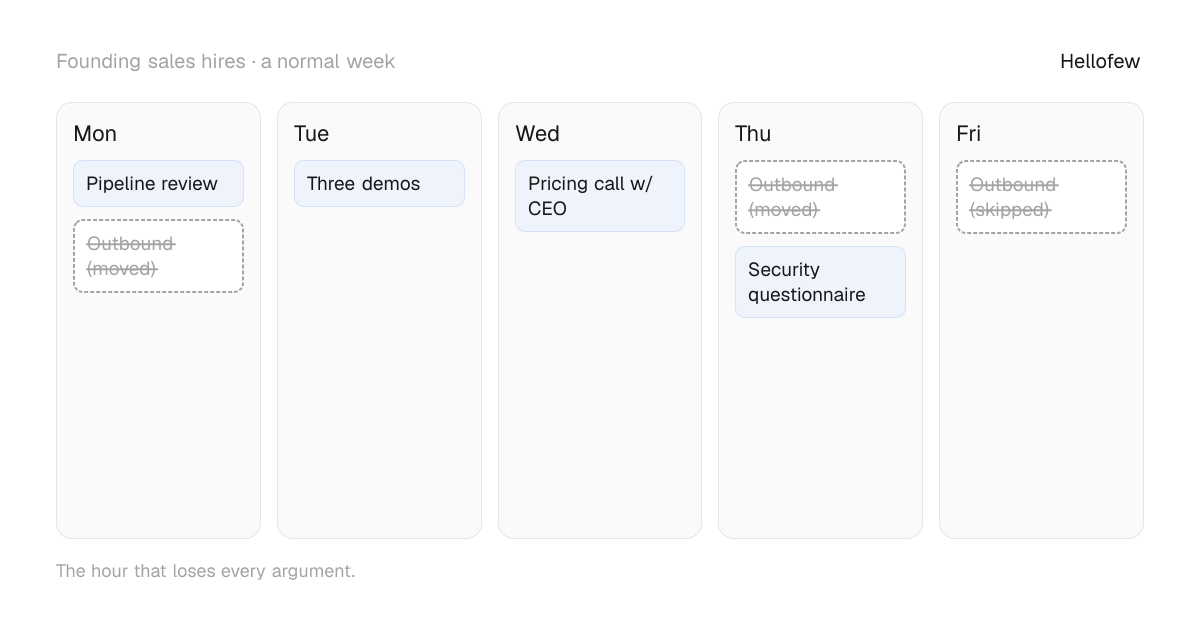
You are closing and prospecting with the same eight hours
Demos and follow-ups fill the day, so prospecting happens at night or not at all. Then the pipeline empties, and the demos stop, and the whiteboard number looks further away.
What happens instead
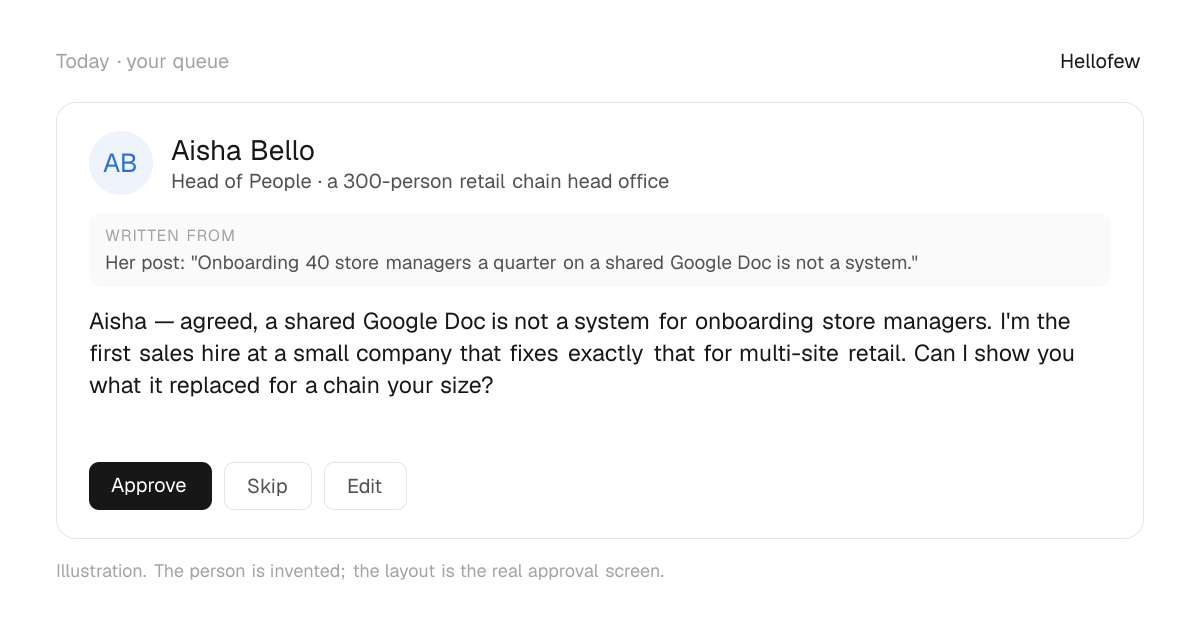
The agents search, read and write every weekday. Your part is approving up to 25 people each morning, each with the reason they were picked and a draft already written.
The ICP is a guess, and you are supposed to validate it
Nobody knows yet exactly who buys. The founders have hunches. You need a way to test titles and angles quickly without burning through the market.
What happens instead
The ICP is a text box you edit — titles, positioning, three angles. Every lead shows a fit score broken into its parts, and your skips show you where the targeting is wrong. Replies, reported every Monday, are the test.
Your LinkedIn is your career, not the company's asset
When you move on, the account goes with you. So does your reputation with every buyer you messaged. A restriction, or a reputation for spam, follows you to the next role.
What happens instead
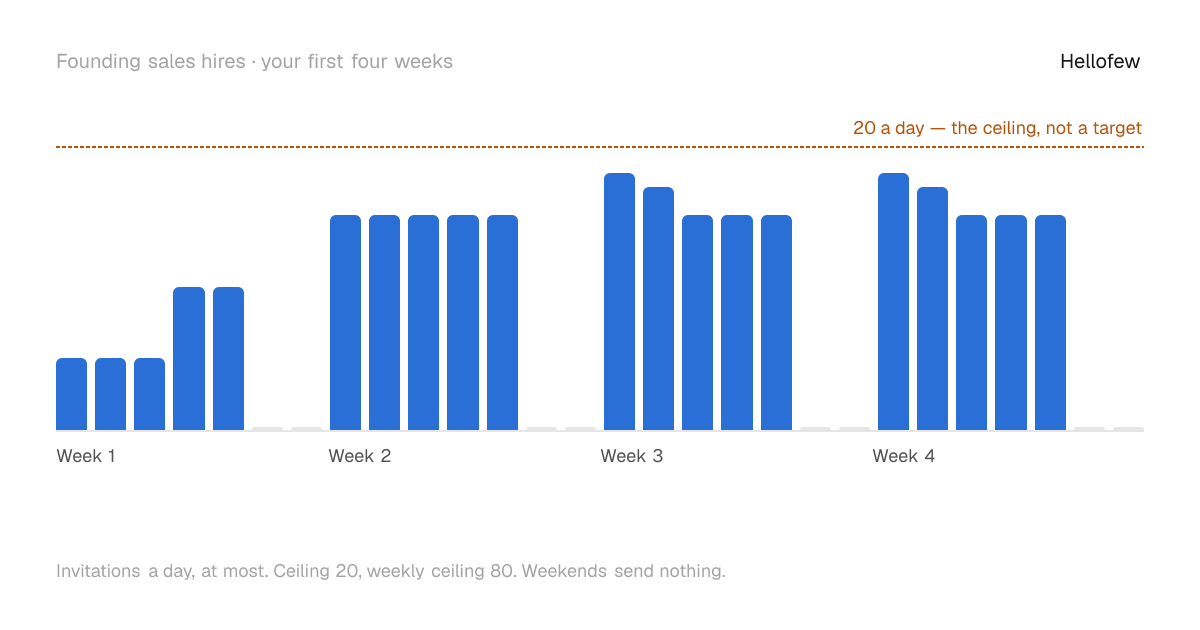
A hard ceiling of 20 invitations a day, reached over a three-week ramp from 5. If acceptance drops, the cap halves; if it keeps dropping, inviting stops before LinkedIn acts. Much safer than the category — never risk-free, and the limits are published so you can check.
You will be asked for numbers, and they had better be honest
The founders want to know what is working. A tool that reports thousands of invitations sent makes a nice chart and tells them nothing.
What happens instead
The Monday digest leads with replies, the only number that matters, and on a quiet week it says why. No vanity metrics to explain away.
What your morning looks like instead
One card per person. Who they are, what the message was written from, and the message itself — so you can judge it in the three seconds you actually have. Approve, skip, or edit. Nothing goes out under your name that you have not read.
Who the agents would go looking for
Typical titles for this kind of buyer. Yours are written from your own page, and you edit them.
- Head of Operations
- VP of Finance
- Director of IT
- Head of People
- Chief Operating Officer
- Operations Director
Your first month
- 1
Paste your company's product page and read the ICP it writes. Edit it to match what the founders believe and what you have heard on calls. Free, no card.
- 2
Subscribe at $49/month and connect your own LinkedIn account. About a minute later, up to 25 people appear, each with a draft written from their profile.
- 3
Approve three and it starts: 5 invitations a day, building over three weeks towards 20. Nothing sends that you did not read.
- 4
Replies land in one inbox and stop the queue for that person. The Monday digest reports replies — the number to take to the founders.
Who this is wrong for
If you need activity logged in Salesforce or HubSpot, there is no CRM sync — you would be copying replies across by hand. If the plan is to hire three SDRs next quarter and run them all from one tool, this is one account for one person. And if leadership wants hundreds of touches a week, the caps will not bend.
Questions
Does it sync with our CRM?
No. It runs one LinkedIn account and keeps its own ledger of everyone contacted and every reply. If CRM sync is a requirement, a tool built for sales teams is the better choice.
Whose account does it use?
Yours, connected by you on LinkedIn's own sign-in page. The account must be yours; we never see the password.
Can the company pay for it?
Yes, it is a normal subscription at $49/month with no contract. It is still tied to one person's LinkedIn account.
The first step costs nothing: paste your page and read what it writes about your market. If it gets your buyers wrong, you have learned something for free. $49/month when you connect LinkedIn and it starts finding real people.