For fractional CMOs
You run demand generation for three clients. Your own pipeline is whoever happens to call when a contract ends.
You are good at this. You have built the funnel, rewritten the positioning, fixed the attribution and hired the first marketer for companies that could not afford a full-time CMO. Your clients’ pipelines are healthier than they have ever been.
Yours is a referral and a prayer. Every engagement ends eventually — the client raises and hires a full-time head, or the budget changes — and every time, there is a gap of two or three months while you find the next one. You know exactly how you would fix this for a client. You have never had the hours to do it for yourself.
The irony is the worst part. You would tell any founder that outbound needs to run steadily, weekly, before you need it. And your own outbound happens in the fortnight after a contract ends, when you are writing from urgency and it shows.
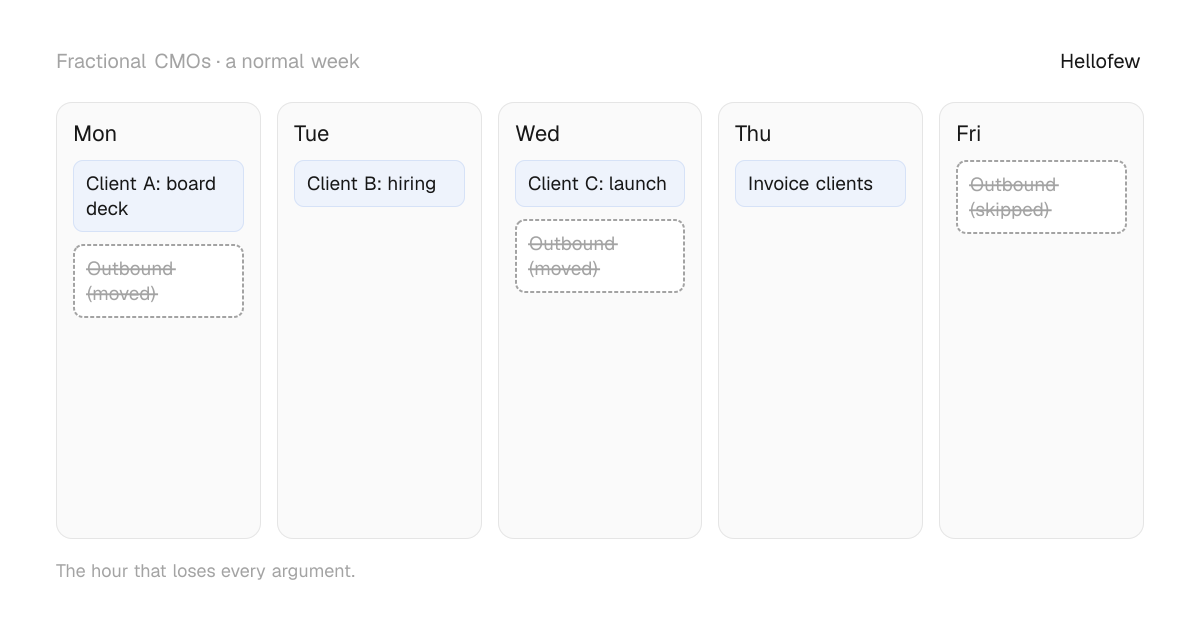
So hand over the hour
Hellofew runs it steadily for you. You paste your services page; agents propose the founders and CEOs who fit your kind of engagement, find them, read what they post, and write one note to each. You approve in a minute between client calls, and it sends from your own account while you do the billable work.
What actually goes wrong
The gap between engagements is where the money goes
A contract ending in eight weeks feels like plenty of time until you realise a founder takes six weeks to decide to hire a fractional CMO, and you have not started any conversations.
What happens instead
The agents work every weekday whether you have three clients or none. By the time a contract ends, there have been weeks of conversations started, instead of a scramble.
Your audience is marketers’ worst critics: founders who have been pitched
A founder who needs a CMO has usually been pitched by five agencies this month. They can tell a template instantly, and a fractional CMO sending a template is the worst possible advertisement for your judgement.
What happens instead
Each note is written from the founder’s own profile and recent posts. If they wrote about a growth problem, the note speaks to that problem — and any quote is checked against their actual words before it reaches you. Near-duplicates are thrown away and rewritten.
You cannot be seen spraying the network your reputation lives in
Your LinkedIn is your portfolio. Former clients, investors who refer you and peers who pass on work all see it. A tool that fires hundreds of invitations a week is a risk to the one channel your business depends on.
What happens instead
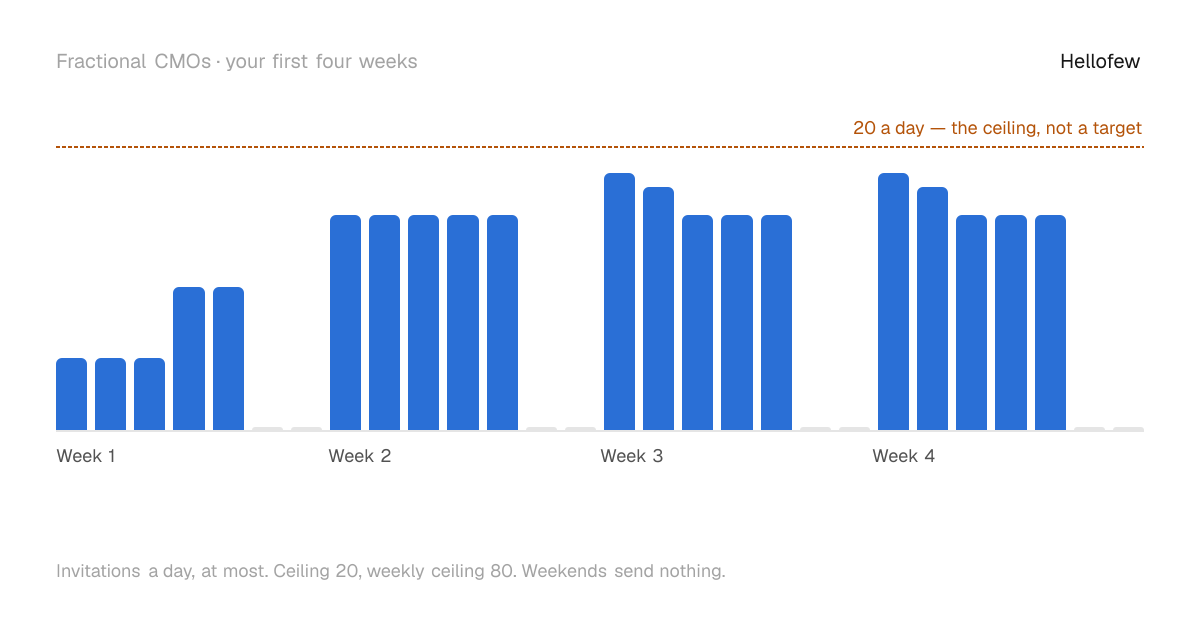
A hard ceiling of 20 invitations a day and 80 a week, reached over a three-week ramp. If acceptance falls the cap halves on its own; if it falls further, inviting stops. The limits are published and cannot be raised by you or by me — materially safer than the category, not a guarantee.
Replies from prospects get buried under client messages
Your LinkedIn inbox is full of client threads, recruiters and agency pitches. A founder who said “let’s talk in January” disappears under them by Friday.
What happens instead
Replies to your outreach land in one inbox and cancel everything still queued for that person, so no founder who answered gets an automated nudge. The Monday digest lists who replied that week.
What your morning looks like instead
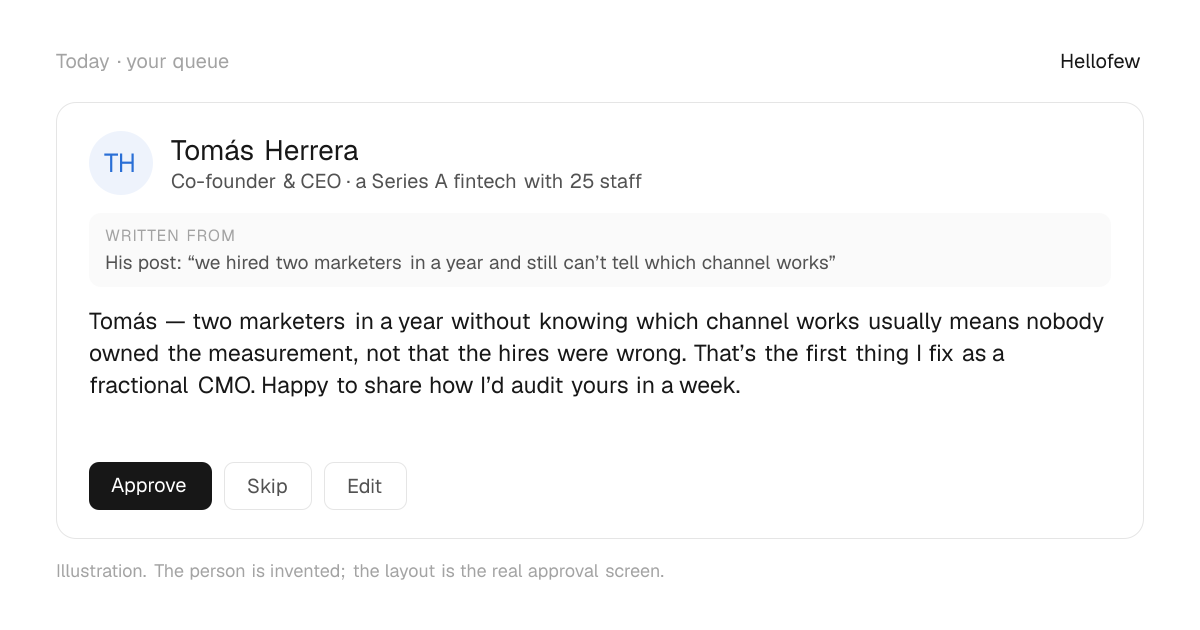
One card per person. Who they are, what the message was written from, and the message itself — so you can judge it in the three seconds you actually have. Approve, skip, or edit. Nothing goes out under your name that you have not read.
Who the agents would go looking for
Typical titles for this kind of buyer. Yours are written from your own page, and you edit them.
- Founder & CEO
- Co-founder
- CEO
- Chief Revenue Officer
- Managing Director
- Head of Growth
Your first month
- 1
Paste your services or about page — free, no card. Check that the ICP describes the stage and size of company you actually want as a client, not just any founder.
- 2
Subscribe at $49/month and connect LinkedIn. About a minute later, up to 25 founders and CEOs in the queue, each with a reason and a note written from their profile.
- 3
Approve three and sending starts at 5 a day, climbing over three weeks towards 20, only during your working hours.
- 4
Accepted connections get one message and one follow-up at most. The Monday digest counts replies — the number that tells you whether your next engagement is lined up.
Who this is wrong for
If most of your work comes from a network of VCs who refer portfolio companies to you, that channel is better than cold outreach and you should protect it. If you run a marketing agency with a team to feed, you need more volume and more seats than this gives. And if you want to post content and be found, that is a different job — this writes one-to-one messages, not posts.
Questions
Can it target founders who just raised?
It reads each person’s profile and recent posts; someone who has posted about a raise or about hiring will have that reflected in the note and in their score. It does not subscribe to funding databases.
Will it mention my past clients?
Only what you put in your positioning and angles. The drafts are written from what you give it and from what the recipient wrote, and you approve every one.
What if I land three clients and need to pause?
Stop approving and nothing new sends. Cancel and the queue stops the same day. The contacted ledger and the do-not-contact list stay with your account, so you never re-message someone you already wrote to when you start again.
The first step costs nothing: paste your page and read what it writes about your market. If it gets your buyers wrong, you have learned something for free. $49/month when you connect LinkedIn and it starts finding real people.