For professional services
Clients stay with you for a decade. Finding the next one still depends on who you happened to have lunch with.
You run an accounting practice, a boutique law firm, a compliance or HR advisory business. The work is steady and the clients are loyal. New business arrives the way it always has: a referral from a banker, an introduction from an existing client, a partner's golf partner.
Which means growth is something that happens to you rather than something you choose. You would like more of a particular kind of client — the fast-growing company, the sector you are strongest in — and there is no way to go and find them that does not feel like cold-calling, which your profession has always looked down on.
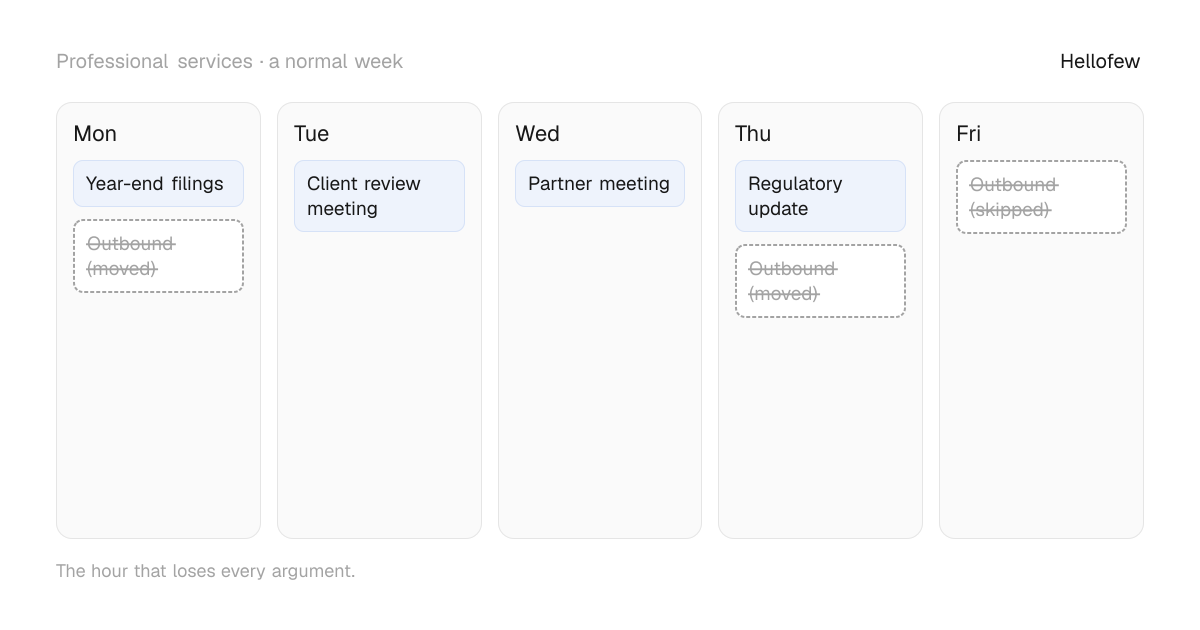
So hand over the hour
Hellofew is a quieter way to go and find them. Paste your firm's site or a service page; agents turn it into the titles of the people who hire firms like yours — finance directors, general counsel, founders at a certain stage — find them, read their profile and posts, and write a measured note to each. You approve every one. It sends from your own account at a pace that looks like a person.
What actually goes wrong
Referrals give you clients, not the clients you want
The referrals are generous and mostly fine. But you want more scale-ups and fewer tiny sole traders, more of the sector you know best. You cannot ask your network to send you only the good ones.
What happens instead
The ICP is yours: the industries, company sizes and five to eight titles you want to work with. Up to 25 matching people arrive each day with the reason they were picked, and skipping anyone is one click.
Your profession punishes anything that looks like selling
A finance director who gets "Are you happy with your current accountant?" thinks less of the sender, not more. A lawyer who sends five follow-ups looks like a lawyer with no clients.
What happens instead
One follow-up, ever, and any reply — including "no thanks" — cancels everything queued for that person. Notes are written from what the recipient actually said, not merged from a template, and you read each one before it goes. Nothing leaves under your name that you did not approve.
Regulated firms cannot afford a careless message
A note that misstates what the recipient said, or promises something your firm cannot say, is not just embarrassing in your line of work. It is the kind of thing that ends up in front of a partner.
What happens instead
Every quoted phrase is checked against the person's own words, and anything that cannot be found is stripped and flagged to you. The ICP's positioning and angles are editable, so the claims the notes can make are the claims you have signed off.
The partner's profile is the firm's reputation
Prospects vet you on LinkedIn. The senior partner's profile carries twenty years of credibility. Having it restricted because a tool sent too much would be a very public embarrassment.
What happens instead
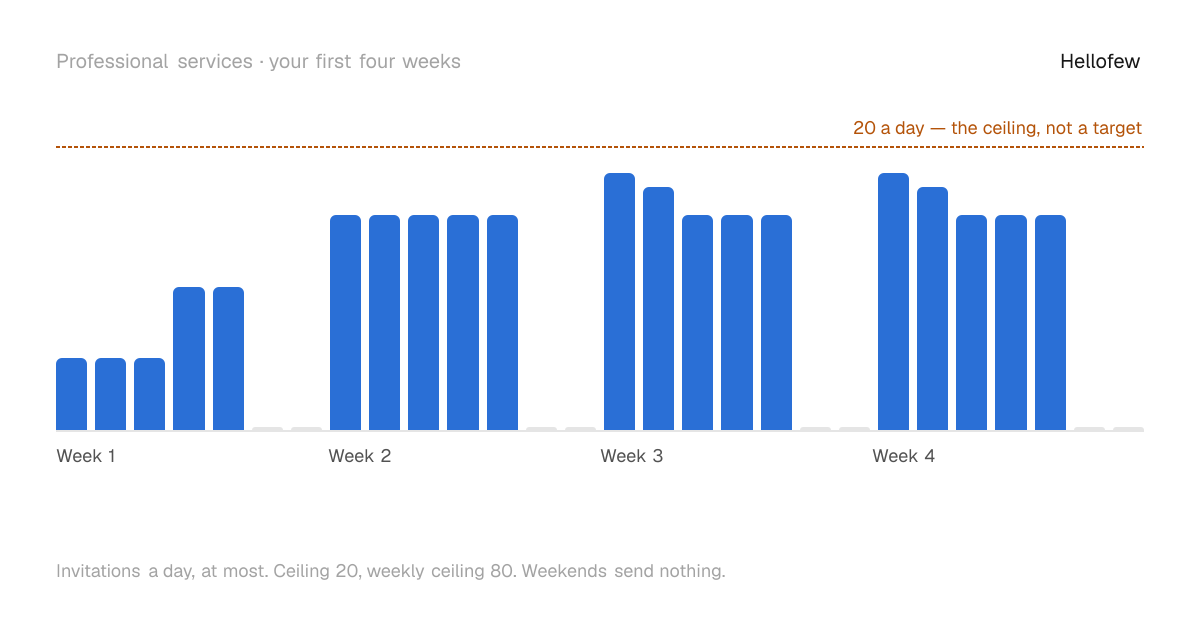
Sending stays inside working hours, twenty minutes clear of either end, at irregular gaps, capped at 20 invitations a day after a three-week ramp. A falling acceptance rate halves the caps, then stops inviting. Materially safer than the category, with every limit published — never risk-free.
What your morning looks like instead
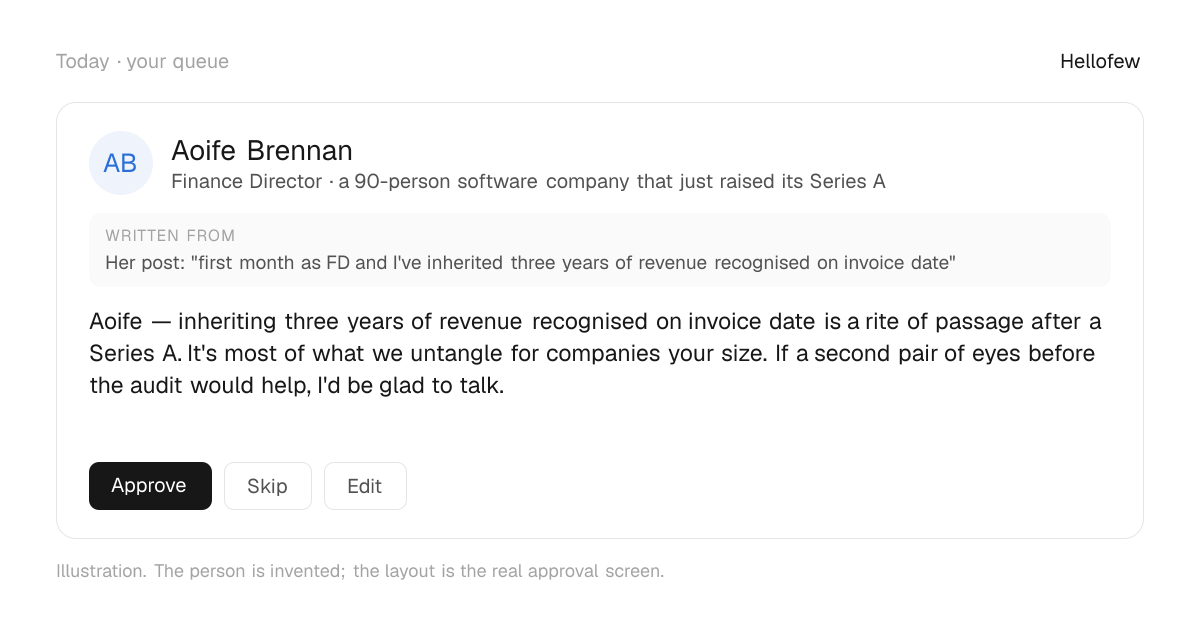
One card per person. Who they are, what the message was written from, and the message itself — so you can judge it in the three seconds you actually have. Approve, skip, or edit. Nothing goes out under your name that you have not read.
Who the agents would go looking for
Typical titles for this kind of buyer. Yours are written from your own page, and you edit them.
- Finance Director
- Chief Financial Officer
- General Counsel
- Head of Compliance
- Founder & CEO
- Head of People
Your first month
- 1
Paste your firm's site or a service page and read the ICP — free, no card. Correct the titles and the positioning so it only says what your firm is comfortable saying.
- 2
Subscribe at $49/month and connect the LinkedIn account prospects will look up. About a minute later, up to 25 people, each with a note and what it was written from.
- 3
Approve three and sending starts: 5 invitations a day, rising over three weeks towards 20, weekdays only, public holidays skipped.
- 4
One message per accepted connection, one follow-up at most, and every reply in one inbox. Monday's digest tells you who replied — and on a quiet week, why.
Who this is wrong for
If your firm's rules prohibit unsolicited approaches altogether, check with your compliance lead first — this cannot make an approach compliant. If you need every touch logged in a practice-management system, there is no CRM sync. And if several partners each want outreach, this covers one person's account only.
Questions
Is LinkedIn outreach appropriate for a regulated firm?
That is a question for your own regulator and compliance lead, not for software. What this does is keep it measured: you approve every message, the claims come from positioning you control, and there is one follow-up at most.
Will it contact someone who asked us not to?
No. Anyone who asks not to be contacted goes on a permanent do-not-contact list, and that list is never deleted.
Can I use it for a specific service line?
Yes — give it the page for that service and it writes the ICP around it. You can edit the ICP whenever you change focus.
The first step costs nothing: paste your page and read what it writes about your market. If it gets your buyers wrong, you have learned something for free. $49/month when you connect LinkedIn and it starts finding real people.