For B2B SaaS
The product is good. The pipeline depends on whether you had a spare hour this week.
You shipped the thing. A handful of customers use it every day and would be annoyed if it went away. You know, roughly, who else would buy it: a job title, a company size, a problem they complain about in public. They are on LinkedIn right now.
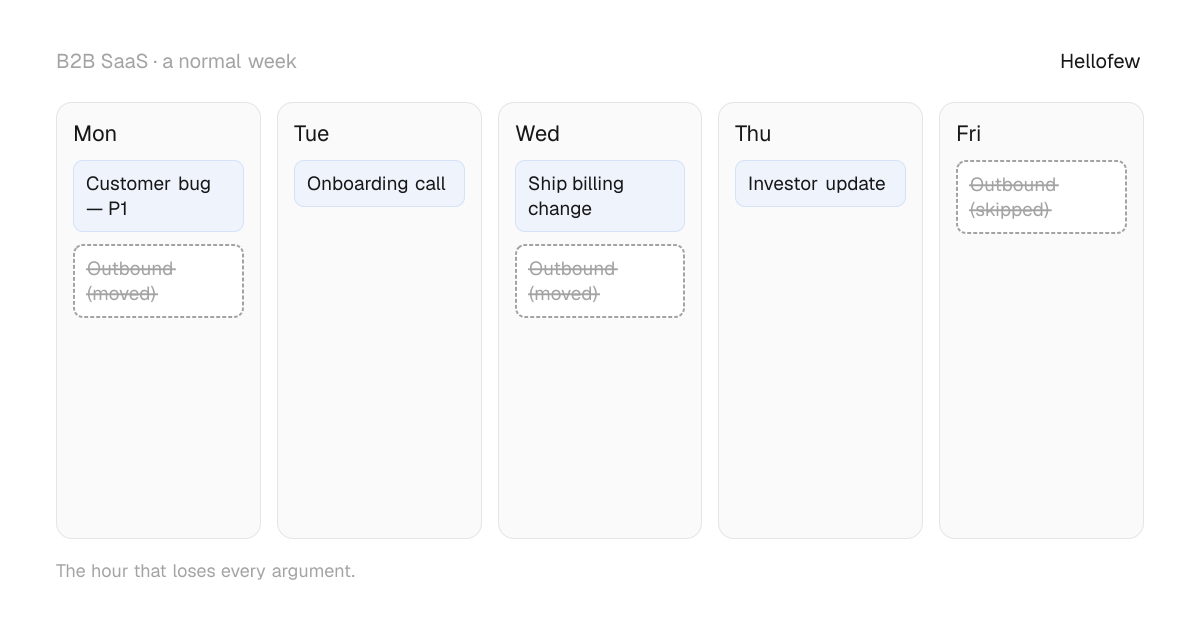
But outbound is the hour that loses every argument. A bug report beats it. A customer call beats it. The roadmap beats it. So it happens in bursts — forty invitations on a Sunday night when the numbers look bad, then nothing for three weeks — which is the worst possible pattern for both the reply rate and the account.
So hand over the hour
Hellofew does that hour every day instead. You paste your pricing or product page; agents turn it into the job titles worth looking for, find those people, read each profile, and write one message per person. You spend a minute in the morning approving the ones you like. It sends from your own account, follows up once, and stops the instant somebody answers.
What actually goes wrong
Outbound only happens in the weeks it is least likely to work
The week MRR dips is the week you finally sit down and send a batch. By then you are writing from anxiety, the messages read like it, and a burst of invitations from an account that was silent last week is exactly the pattern LinkedIn notices.
What happens instead
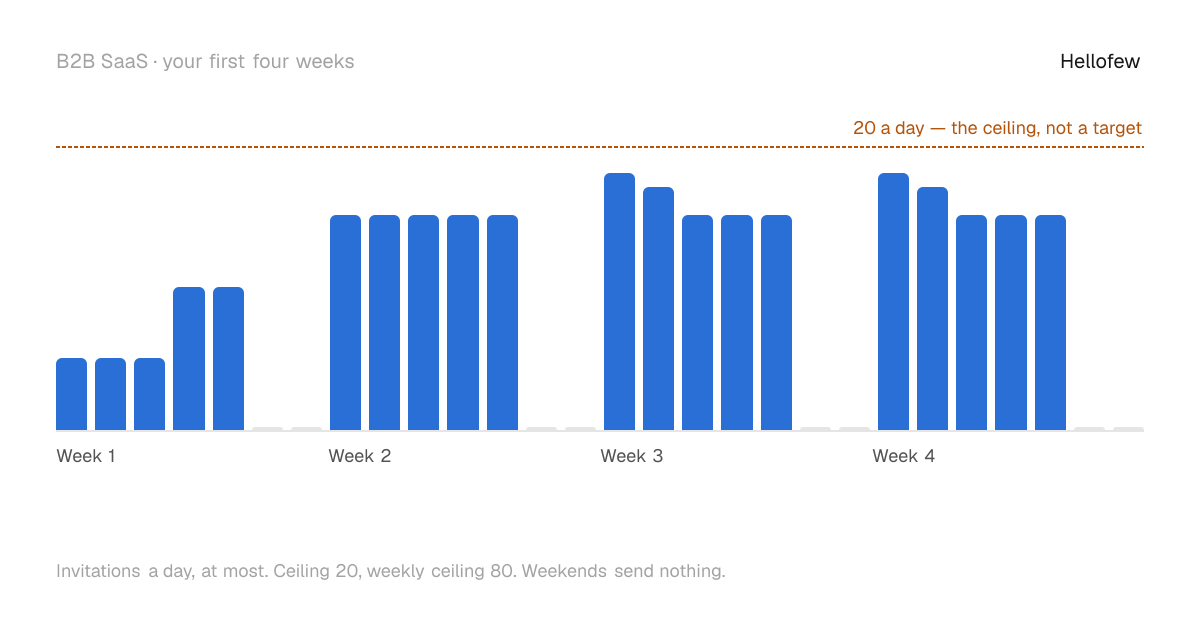
The agents run every weekday whether you had a good week or not, inside your working hours, at irregular gaps. A new account starts at 5 a day and climbs over three weeks to a ceiling of 20. Steady beats heroic, and it is the only pattern that is still working in month six.
Every tool writes the same note with the name swapped
You have received them: "Hi Sam, I noticed you're the Head of Ops at Acme and thought you'd be interested in…" You delete them in under a second. So does your buyer. A search result carries a name, a headline and a location, and a note written from that can only ever be a greeting bolted onto a job title.
What happens instead
Each person's profile and recent posts are read before anything is written. If they said something worth answering, the note answers it — and every quoted phrase is checked, character for character, against what they actually wrote. A quote that cannot be found is stripped and flagged to you. A draft too close to a recent one is thrown away and rewritten.
You cannot afford to lose the account the whole company runs on
Your LinkedIn profile is the company's front door. Investors check it, candidates check it, your first customers found you through it. The tools built for sales teams treat it as a disposable sending channel, and they can, because it is not theirs.
What happens instead
Nothing sends from an account with fewer than 150 connections, because a near-empty profile sending invitations is the pattern LinkedIn most reliably restricts. If your acceptance rate falls, the daily cap halves on its own; if it keeps falling, inviting stops and you are told why. None of this makes an account unbannable — nothing can — but every limit is published, so you can check it.
Replies get lost between LinkedIn, your inbox and your head
Someone replied "interesting, send me something" nine days ago and you only noticed because they viewed your profile again. Meanwhile a sequence tool would have sent them a cheerful "just bumping this up" on day four.
What happens instead
Every reply lands in one inbox and cancels everything still queued for that person — checked twice, right up to the moment of sending. Nobody who has answered you ever gets chased. A weekly digest says how many people replied, and on a quiet week it says why.
What your morning looks like instead
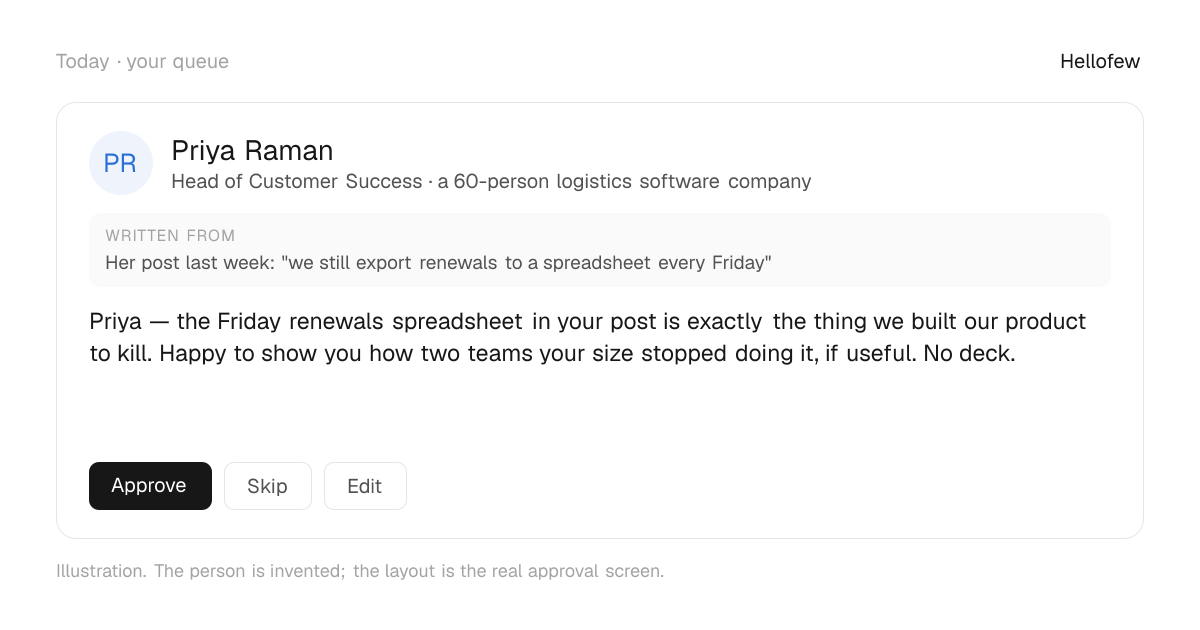
One card per person. Who they are, what the message was written from, and the message itself — so you can judge it in the three seconds you actually have. Approve, skip, or edit. Nothing goes out under your name that you have not read.
Who the agents would go looking for
Typical titles for this kind of buyer. Yours are written from your own page, and you edit them.
- Head of Operations
- VP of Customer Success
- Director of RevOps
- Head of Finance
- COO
- Founder & CEO
Your first month
- 1
Day one: paste your product page and read the ICP it writes. It is free and needs no card. If the job titles are wrong, edit them — or learn that your positioning is less clear than you thought, which is worth knowing for nothing.
- 2
Subscribe at $49/month and connect LinkedIn on LinkedIn's own sign-in page. About a minute later, your first queue: up to 25 people, each with the reason they were picked and a note written for them.
- 3
Approve three and sending starts. 5 invitations a day at first, rising over three weeks towards 20, weekdays only, never within twenty minutes of either end of your working day.
- 4
People who accept get one message written for them, and one follow-up if they do not answer. Replies land in one inbox. Every Monday a digest says how many people replied — including, honestly, the weeks when nobody did.
Who this is wrong for
If you sell self-serve at $9 a month to anyone with a credit card, LinkedIn outbound is the wrong channel and so is this. If you have three SDRs and a Salesforce instance, it is too small: it runs one LinkedIn account for one person, with no CRM sync. And if what you want is a thousand invitations a month, buy something else — this caps you at 20 a day on purpose.
Questions
Will it work if my ICP is broad?
It works better if it is not. The first thing it does is read your page and propose five to eight specific job titles. A broad ICP produces a queue you skip most of, and your skips are the signal that the targeting needs tightening.
Can it sell to my existing users' bosses?
It finds people by title, company and profile, not from your product's data. If the buyer is a different title from the user, put that title in the ICP and it will look for them.
Is it safe for my LinkedIn account?
Materially safer than the category, and not risk-free — LinkedIn's terms prohibit automation, and nobody can promise an account will never be restricted. What you get is a hard ceiling of 20 invitations a day, a three-week ramp, and automatic slow-downs, all published so you can check them.
The first step costs nothing: paste your page and read what it writes about your market. If it gets your buyers wrong, you have learned something for free. $49/month when you connect LinkedIn and it starts finding real people.