For independent security consultants
You found the vulnerability their last three auditors missed. The CISO who should hear about you has muted every message with “security” in it.
You are independent because you are good: penetration testing, cloud reviews, incident response, the audit prep that actually passes. Your clients trust you with the keys, and they send friends when they remember to.
Security leaders are the most pitched people on LinkedIn. Every vendor in the industry is writing to them, all the time, about zero-trust and platforms and threat intelligence. They have learned to treat any cold message as noise, and a surprising number of those messages are themselves phishing.
So your honest, specific offer arrives looking exactly like the noise. And you, of all people, know how a message that fakes familiarity reads — like a social engineering attempt — and you would not send one.
So hand over the hour
Hellofew writes to them carefully instead. You paste your services page; agents find security leaders at the kind of companies you work with, read their profiles and recent posts, and write one short note per person with no pretend familiarity. Every quote is checked against what they actually wrote, and nothing leaves your account until you approve it.
What actually goes wrong
Security leaders filter cold messages harder than anyone
A CISO’s LinkedIn inbox is a wall of vendor pitches. They reply to people they know, people who reference something real, and nobody else. Your message has about a second to be the second kind.
What happens instead
Each note is written from the person’s profile and recent posts, so it opens on what they have said or done rather than on a product category. A draft too close to a recent one is thrown away and rewritten.
A fabricated detail is indistinguishable from a phishing lure
“Loved your talk at the conference” to someone who never gave one is annoying from a salesperson. From a security consultant it looks like pretexting, and it ends the relationship before it starts.
What happens instead
Quotes are verified with a string comparison, not another model: every quoted phrase must appear verbatim in what they actually wrote. If it does not, the draft is regenerated once, and failing that, the marks are stripped and it is flagged to you. Reposts are excluded, and the profile read does not show up in their “who viewed your profile” before your message does.
Billable work always wins the week
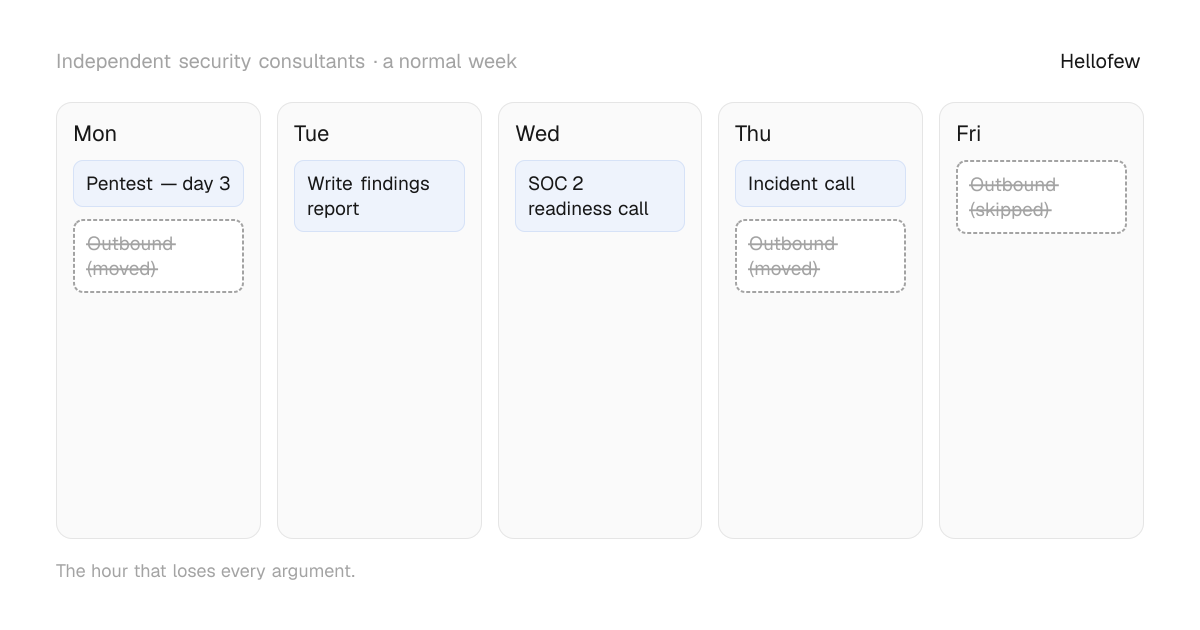
A test runs over, a report needs rewriting, an incident call eats a Thursday. Business development is always the thing you will do when the engagement finishes.
What happens instead
The research and writing run every weekday. Your part is a minute of reviewing the queue — approve, skip or edit — and approving three is what starts it.
Your reputation is the whole business
An independent consultant is only as good as their name. Being visibly restricted for automated outreach, in an industry obsessed with doing things properly, would be a story people tell.
What happens instead
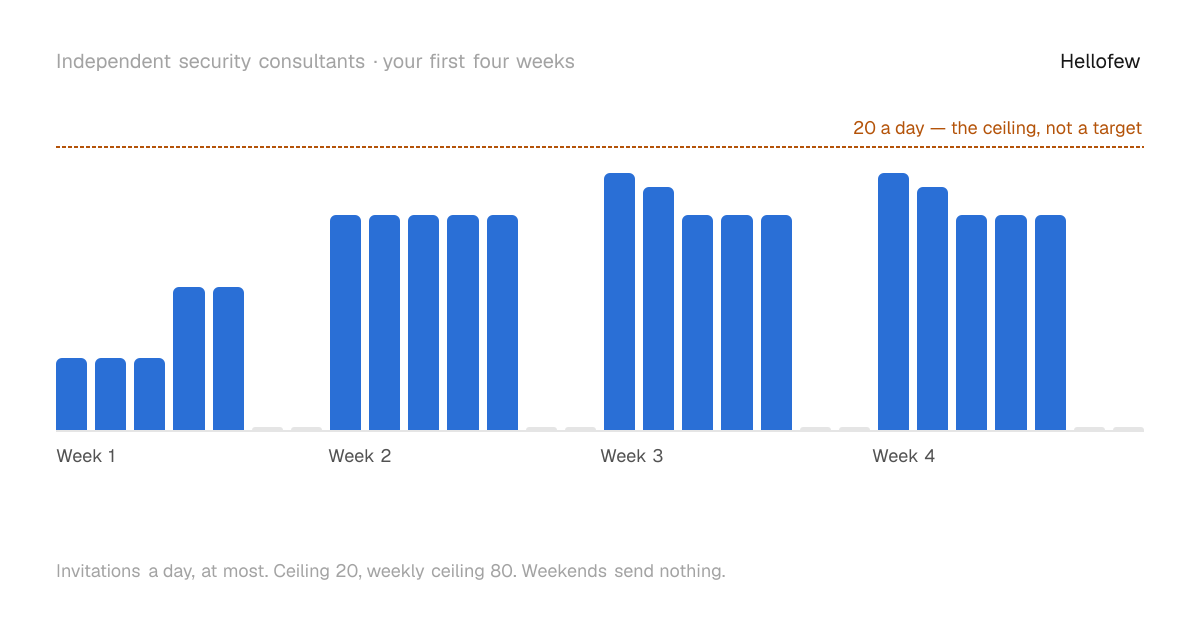
At most 20 invitations a day and 80 a week, ramped over three weeks from 5. Nothing sends from an account under 150 connections, acceptance is checked from day four, and a LinkedIn flag in the first day stops sending until you restart it. LinkedIn’s terms prohibit automation, so this is materially safer than the category, not risk-free — and every limit is published so you can audit it.
What your morning looks like instead
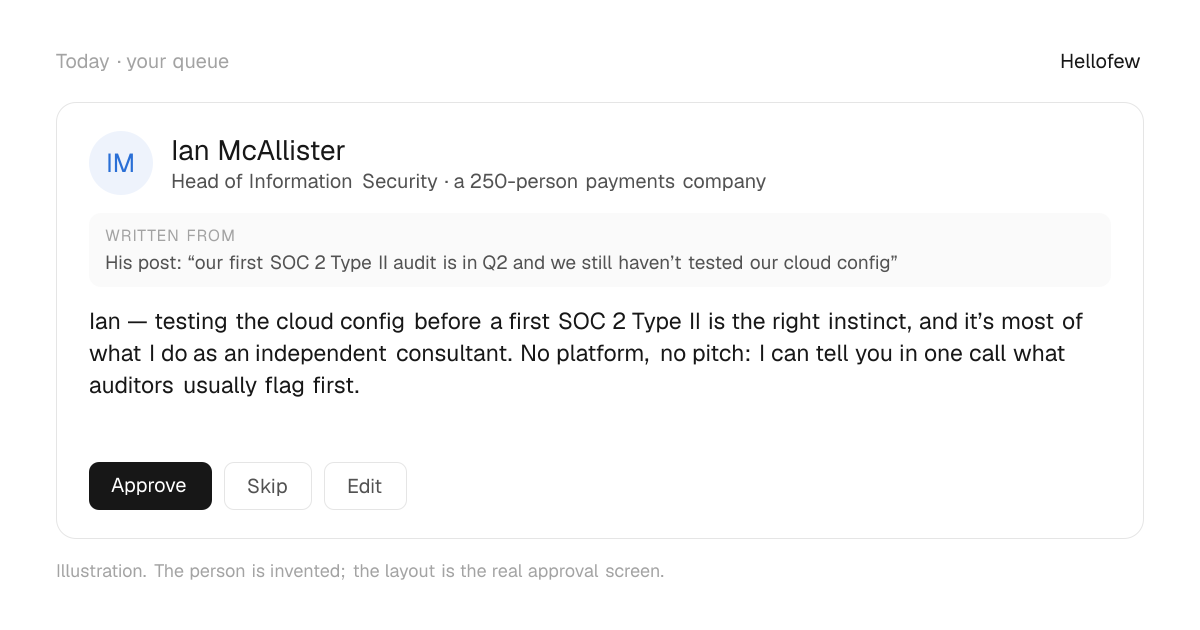
One card per person. Who they are, what the message was written from, and the message itself — so you can judge it in the three seconds you actually have. Approve, skip, or edit. Nothing goes out under your name that you have not read.
Who the agents would go looking for
Typical titles for this kind of buyer. Yours are written from your own page, and you edit them.
- Chief Information Security Officer
- Head of Information Security
- Head of Security
- VP of Engineering
- IT Director
- Head of Compliance
Your first month
- 1
Paste your services page — free, no card. Check the ICP for the size of organisation you actually serve; a CISO at a bank and a Head of Security at a startup need very different notes.
- 2
Subscribe at $49/month and connect LinkedIn on LinkedIn’s own sign-in page. Your password and two-factor code never reach this service. About a minute later there are up to 25 people in the queue.
- 3
Approve three and sending starts at 5 a day, rising over three weeks towards 20. Read the evidence line under each draft; it shows exactly what the note was written from.
- 4
Accepted connections get one message and one follow-up at most. The Monday digest counts replies and explains a quiet week rather than hiding it.
Who this is wrong for
If your work comes through a security firm or a platform that sells your hours, cold outreach may conflict with that arrangement. If you sell to government or large enterprises through frameworks and tenders, this is not how those buyers are reached. And if you need to reach hundreds of organisations quickly after a disclosure, this caps you at 20 a day on purpose.
Questions
Does it ever see my LinkedIn password?
No. You sign in on LinkedIn’s own page through Unipile; your password and two-factor code never reach this service, which holds only an opaque account id.
Where does prospect data go?
Every vendor that touches it is listed on the sub-processors page, with what they see and where. The legal pages set out retention, and a do-not-contact record is kept permanently so nobody who asked to be left alone is ever contacted again.
Can I review exactly what it read before writing?
Yes. Each draft in the queue shows what it was written from, so you can check the evidence before approving.
The first step costs nothing: paste your page and read what it writes about your market. If it gets your buyers wrong, you have learned something for free. $49/month when you connect LinkedIn and it starts finding real people.