For independent consultants
Clients hire you because they trust your judgement. The fastest way to lose that is a cold message that reads like everyone else's.
You left a firm to work for yourself, and most of your first clients came from people who already knew you. That list runs out. Now the question is how to reach the people who need what you do but have never heard of you — without becoming the consultant who spams LinkedIn.
The tension is that the thing you sell is judgement, and outreach is where your judgement is most visible. A thoughtful note to the right person is the best first impression you can make. A templated pitch to a thousand people is the worst, and the tools built for it treat your name as a sending address.
So hand over the hour
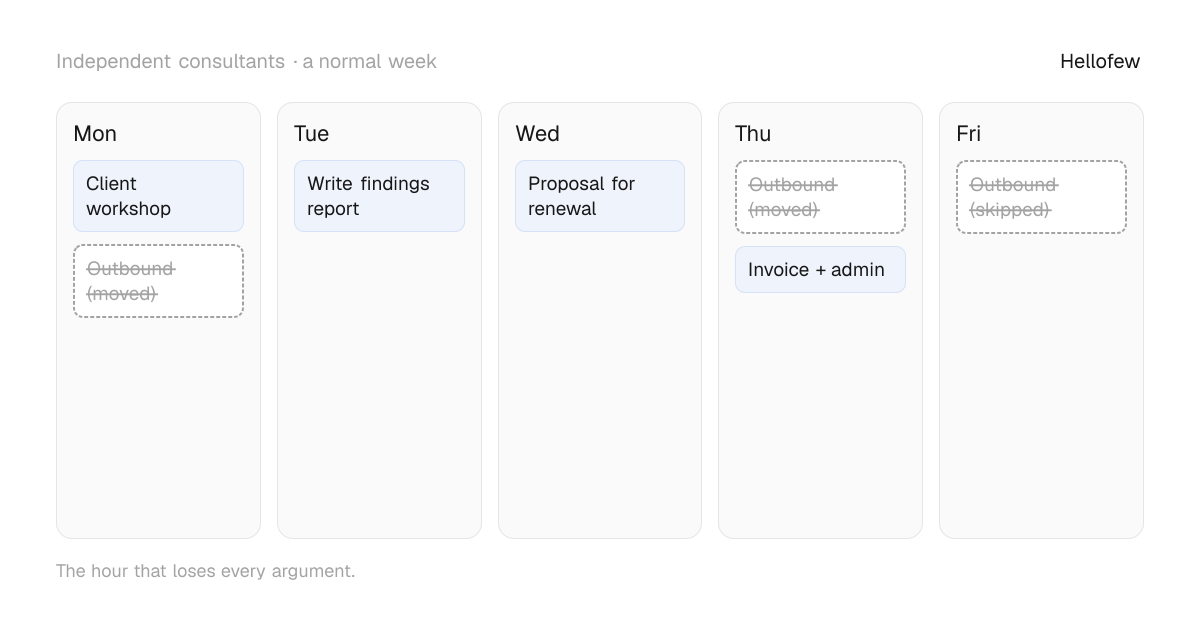
Hellofew finds the right people and writes to them the way you would if you had the hours. You paste your services page; agents turn it into specific job titles and angles, find those people, read their profile and recent posts, and draft one note each. You approve every message. It sends from your account at a deliberately modest pace, follows up once, and stops as soon as someone replies.
What actually goes wrong
Referrals are wonderful and completely unpredictable
Two great months, then a quiet one, then a flurry of work you cannot take on. You cannot plan hiring an associate, or a holiday, on a pipeline that depends on who happened to mention you at dinner.
What happens instead
A small, steady stream of new conversations every week, started by the agents whether you had time or not. Up to 25 matched people a day in your queue, and a Monday digest that tells you how many replied.
Your expertise does not fit in a template
The value of your work is in the specifics — the particular regulation, the particular migration, the particular failure you have seen three times. A generic pitch strips that out and leaves you sounding like every other consultant.
What happens instead
Each note is written from what the recipient actually does and says, using angles drawn from your own page. Every quote is checked verbatim against their posts, and a draft too close to a recent one is rewritten rather than sent.
Chasing feels desperate, and you know it
Sequence tools send four follow-ups by default. From a consultant, the third "just checking in" reads as a person who needs the work more than the client needs them.
What happens instead
One follow-up, ever, and there is no setting to add more. Any reply cancels everything still queued for that person, checked again right before each send, so nobody who answered you gets chased.
Your LinkedIn profile is your storefront and your CV
Prospects check it before a call. Former colleagues check it before referring you. It holds the recommendations it took a decade to collect. Losing it to an automation tool would be losing the business.
What happens instead
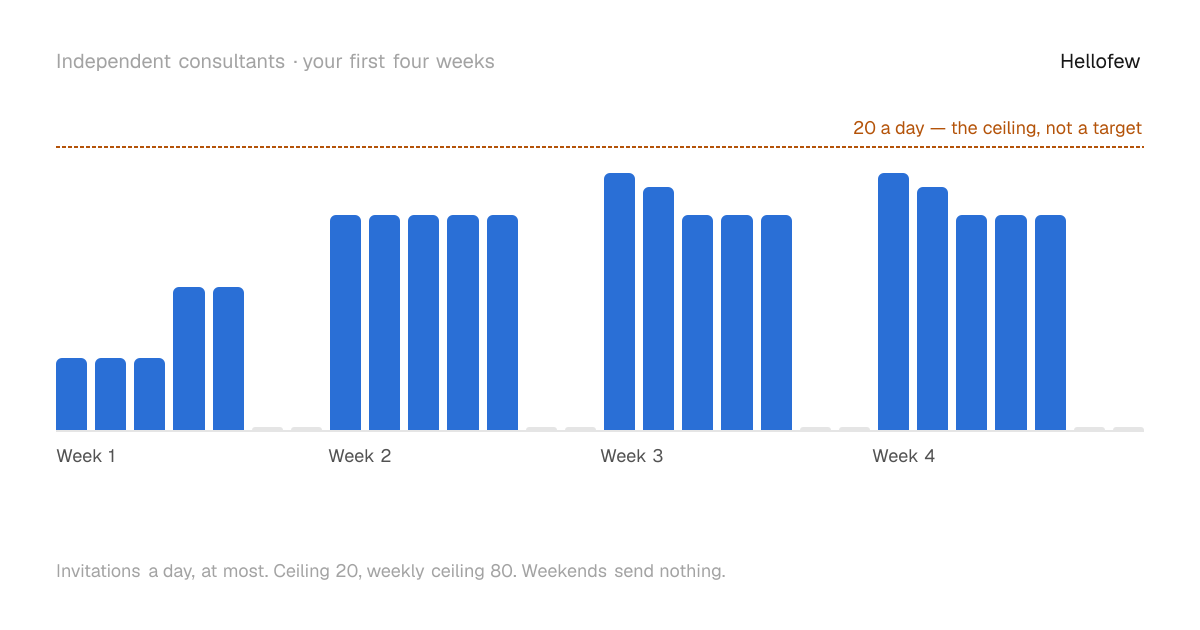
Sending ramps from 5 a day over three weeks to a hard ceiling of 20, only inside your working hours. If acceptance falls, the cap halves; if it keeps falling, inviting stops and you are told. Materially safer than the category — no one can honestly promise more than that.
What your morning looks like instead
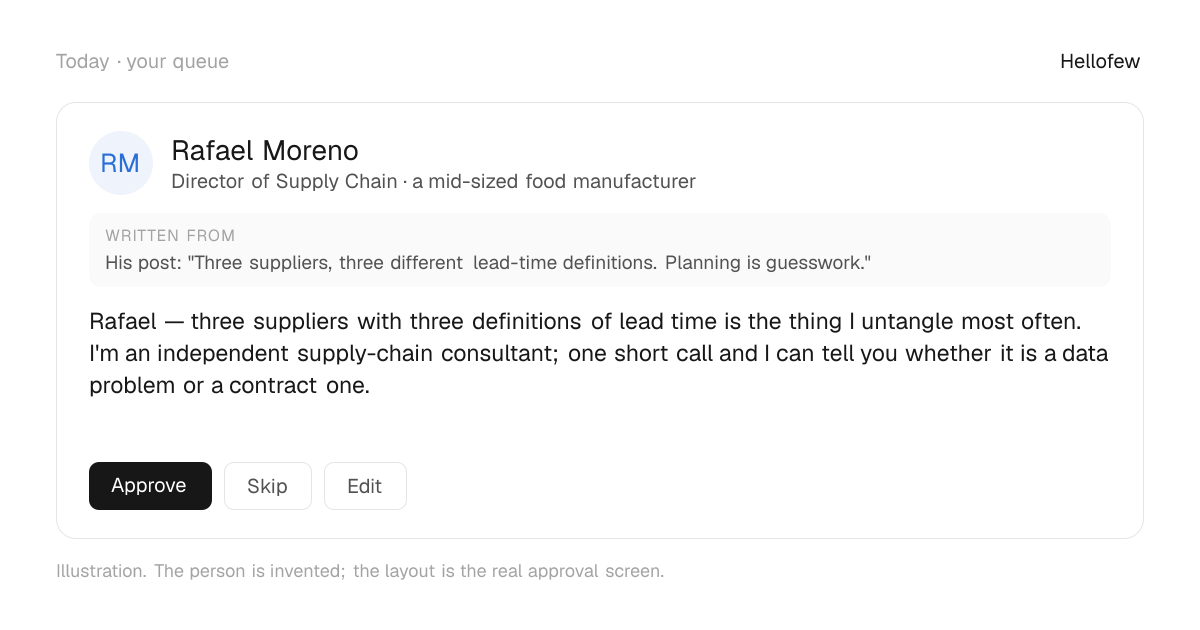
One card per person. Who they are, what the message was written from, and the message itself — so you can judge it in the three seconds you actually have. Approve, skip, or edit. Nothing goes out under your name that you have not read.
Who the agents would go looking for
Typical titles for this kind of buyer. Yours are written from your own page, and you edit them.
- Chief Operating Officer
- VP of Operations
- Head of Transformation
- Director of Supply Chain
- Head of Procurement
- Managing Director
Your first month
- 1
Paste your services page and read the ICP: five to eight titles, your positioning, three angles, a sample note. Edit anything — the specifics are yours. Free, no card.
- 2
Subscribe at $49/month and connect LinkedIn on LinkedIn's own sign-in page. About a minute later, up to 25 people appear with the reason they were picked and a draft each.
- 3
Approve three and sending starts at 5 invitations a day, building over three weeks towards 20. Weekends and public holidays are skipped.
- 4
One follow-up at most. Replies land in one inbox. Each Monday the digest reports replies — and on a quiet week, the reason.
Who this is wrong for
If most of your work comes through a framework agreement or procurement portal, outbound will not move it. If you want to broadcast to thousands of prospects, the limits will not let you. And if you work under a firm's brand with a shared account, this is built for one person's own profile.
Questions
Will it message people I already know?
It searches for new people matching your ICP. You see every person before anything is sent and can skip anyone, and anyone who asks to be left alone is never contacted again.
Does it work for niche expertise?
Better than for broad offers. A narrow ICP produces a queue you approve most of, and each note can speak to a specific problem instead of a general capability.
Is it against LinkedIn's rules?
LinkedIn's terms prohibit third-party automation, and it may restrict accounts it believes are automated. That risk is yours to weigh. What this does is keep your activity well below the category, with the limits published in full.
The first step costs nothing: paste your page and read what it writes about your market. If it gets your buyers wrong, you have learned something for free. $49/month when you connect LinkedIn and it starts finding real people.