For cybersecurity
The CISO you want to reach gets fifty vendor messages a week, and posts the worst ones.
Your product closes a real gap — a class of misconfiguration nobody catches, an identity problem everyone has. Security leaders who see it get it. The trouble is that security leaders are the most over-pitched buyers in business, and many of them have stopped reading vendor outreach altogether.
Some of them go further. "Vendor of the week" screenshots, threads about the worst cold messages, conference talks about how not to sell to a CISO. In your market, a careless message does not just fail, it becomes content. And the fear of that is exactly why you have not done outbound properly.
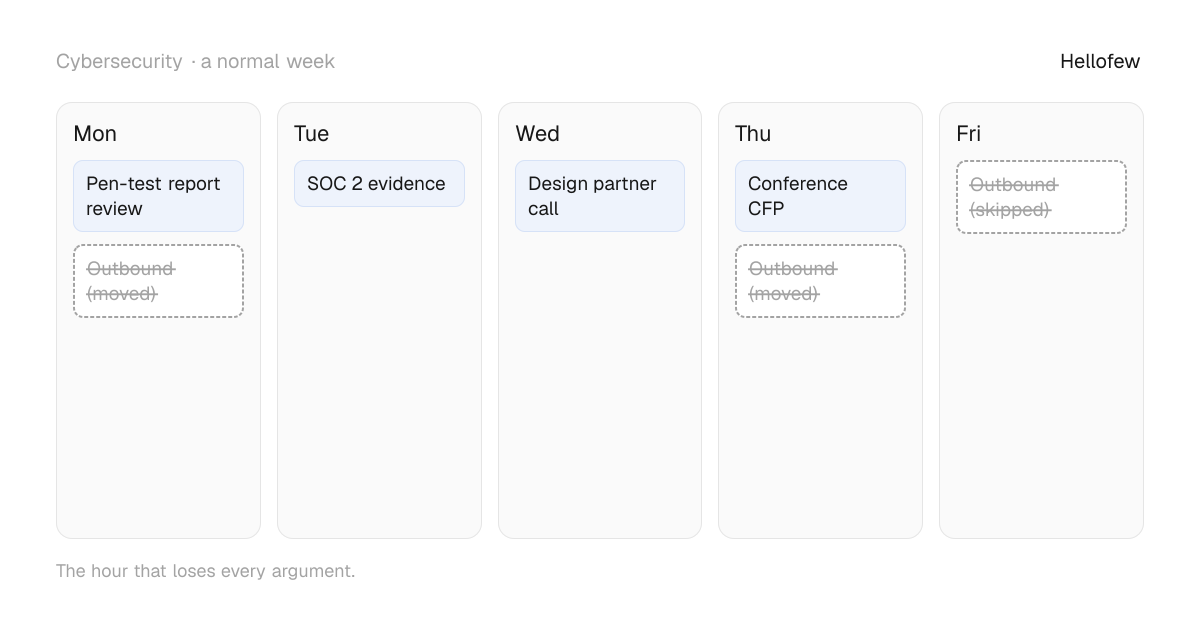
So hand over the hour
Hellofew is built for the buyer who punishes volume. Paste your product page; agents turn it into the security titles that own your problem, find them, read their profile and posts, and write one restrained note per person, grounded in what they said. You approve every message. It sends slowly from your own account, follows up once, and never again after a reply.
What actually goes wrong
Security leaders treat volume as a red flag
A CISO who gets the same note from three people at your company has learned everything about you they need to. Volume signals desperation, and in security, desperation signals a product nobody is buying.
What happens instead
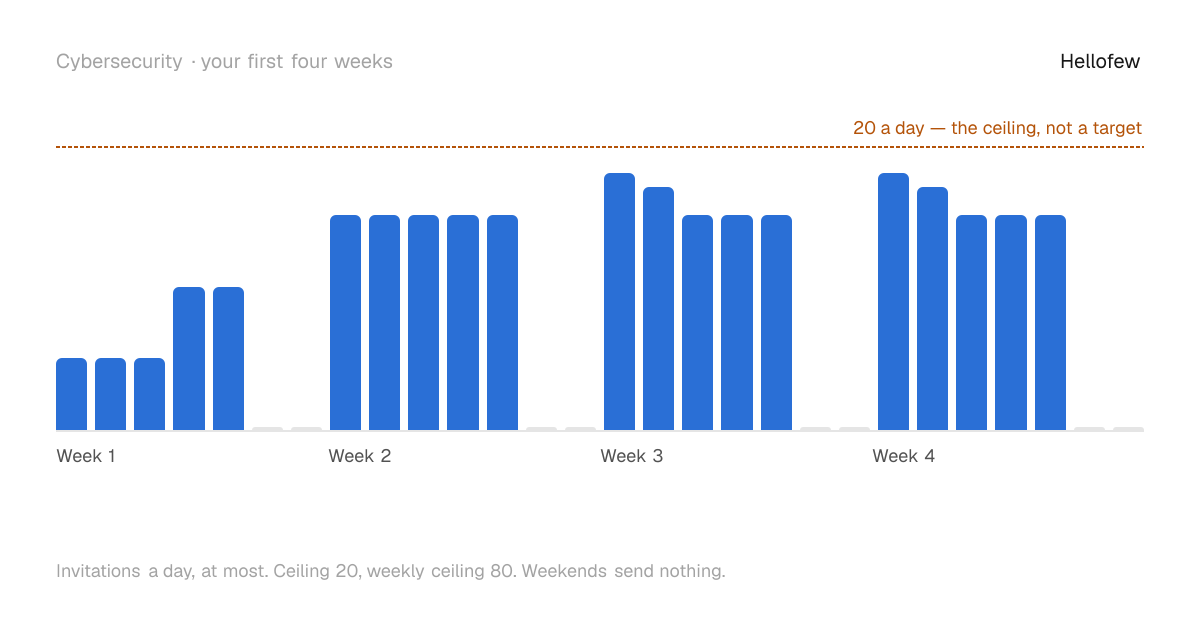
One LinkedIn account, one person, a ceiling of 20 invitations a day reached over three weeks. That is not a limitation to work around — for this buyer it is the point. Every note is individual, and near-duplicates are thrown away and rewritten.
FUD is the default, and it is exhausting
"Did you know 83% of breaches start with…" Every security vendor opens with a scare statistic. The CISO reading it has spent the week with an actual incident and has no patience left for a hypothetical one.
What happens instead
Notes are written from what the person has actually said — a post about alert fatigue, a talk about their zero-trust rollout — not from a scare stat. Any quote is checked, character for character, against their own words, and stripped and flagged to you if it cannot be found.
A misquote to a security leader is a credibility breach
Attributing words to a CISO that they did not say is not a small error in your industry. It says you do not check your inputs — which is the one thing a security buyer is paying you to do.
What happens instead
Quote grounding is a plain string comparison against their own posts and profile, not a second model asked to check its own work. Reposts are excluded, so you never thank someone for an opinion they only forwarded.
The follow-up sequence is the part they screenshot
The first message was fine. It was message four — "Should I assume this isn't a priority?" — that ended up on someone's feed with your logo cropped in.
What happens instead
One follow-up, ever, and no setting to add more. Any reply cancels everything queued for that person, checked twice right up to the send. Anyone who asks to be left alone is added to a permanent do-not-contact list.
What your morning looks like instead
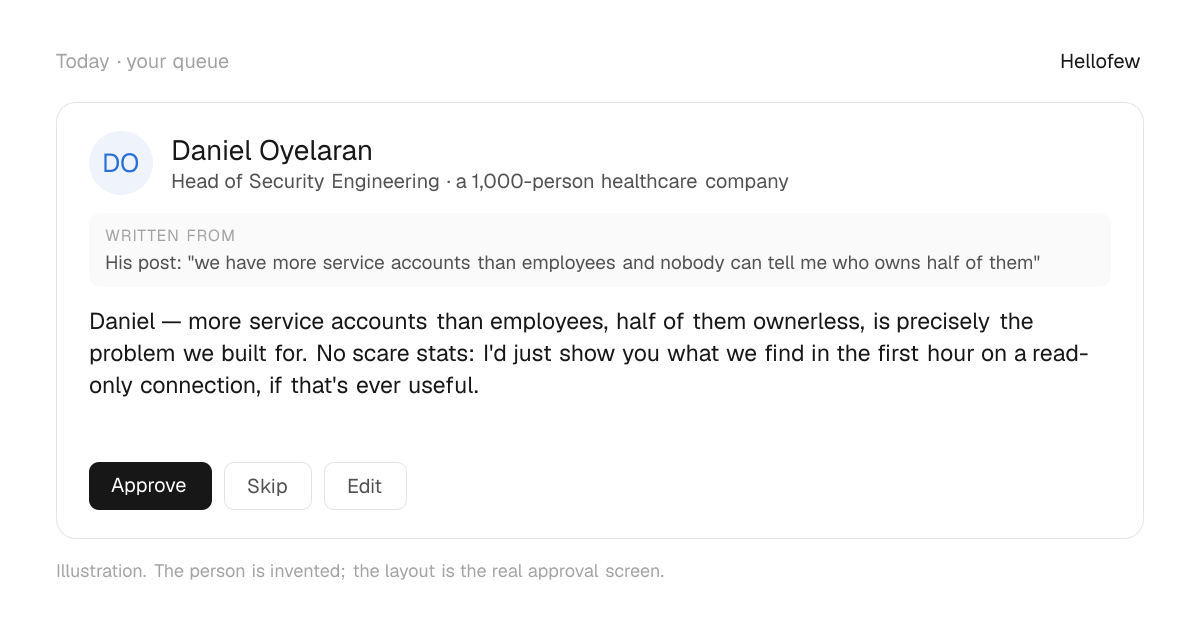
One card per person. Who they are, what the message was written from, and the message itself — so you can judge it in the three seconds you actually have. Approve, skip, or edit. Nothing goes out under your name that you have not read.
Who the agents would go looking for
Typical titles for this kind of buyer. Yours are written from your own page, and you edit them.
- Chief Information Security Officer
- Head of Security Engineering
- Director of Security Operations
- VP of Information Security
- Head of Identity and Access Management
- Security Architect
Your first month
- 1
Paste your product page and read the ICP — free, no card. Look hard at the angles; if any lean on fear, rewrite them there and every draft follows.
- 2
Subscribe at $49/month and connect your LinkedIn. About a minute later, up to 25 security leaders, each with the reason they were picked and what the note was written from.
- 3
Approve three and sending starts: 5 invitations a day, building over three weeks towards 20, weekdays only, inside your working hours.
- 4
One message to each person who accepts, one follow-up at most, every reply in one inbox. Monday's digest reports who replied — and on a quiet week, why.
Who this is wrong for
If you sell into large enterprises through channel partners and a field sales team, this is too small — one account, no CRM sync. If you want the whole security team at a target account messaged at once, it will not do that. And if your only message is a scare statistic, fix the positioning first: this writes from your page.
Questions
Will it message several people at the same company?
Only if they match your ICP and you approve each one. Every person is shown to you before anything is sent, and skipping is one click.
Where does my prospect data go?
The sub-processors, what each sees and how long anything is kept are published in full on the legal pages. Your LinkedIn password and 2FA code never reach us.
Can it guarantee my account is safe?
No, and nobody honestly can — LinkedIn's terms prohibit automation. What you get is a published ceiling of 20 invitations a day, a three-week ramp, and automatic slow-downs that act before LinkedIn does.
The first step costs nothing: paste your page and read what it writes about your market. If it gets your buyers wrong, you have learned something for free. $49/month when you connect LinkedIn and it starts finding real people.