For fractional executives
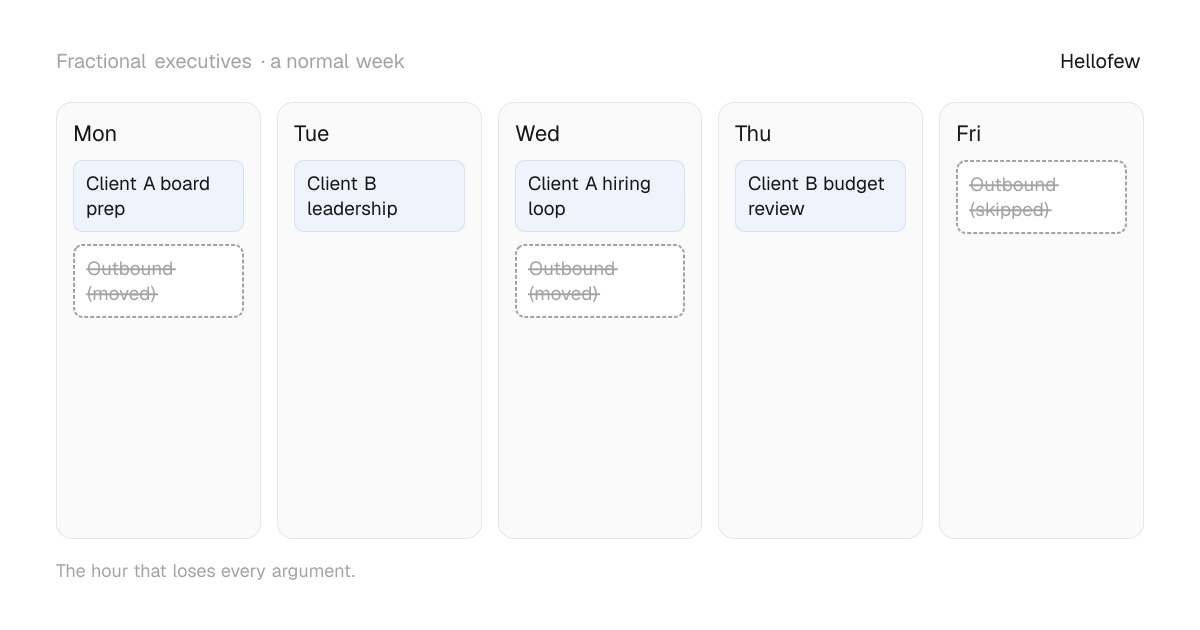
Every engagement ends eventually. The next one has to already be in conversation, and you have been too busy doing the work to start one.
You sell your own time, a few days a week, to companies that need a senior hand but not a full-time hire. The work is good. The clients are happy. And every few months you look at the calendar and realise two engagements end in the same quarter and nothing is lined up behind them.
Your pipeline has always been referrals and your network, which works until it does not. Outbound would fix it, but your LinkedIn profile is not a sales channel — it is your reputation. Every former colleague, every past CEO you worked with, sees what you post and who you message. One clumsy template sent at volume and the people most likely to refer you start to wonder.
So hand over the hour
Hellofew runs outbound the way a careful person would do it themselves. You paste your services or about page; agents work out which companies and titles need what you do, find those people, read each profile and write one note per person. You approve every one before it goes. It sends from your account, slowly, follows up once, and stops the instant somebody replies.
What actually goes wrong
Feast, famine, and the gap between engagements
When you are busy, you do not prospect because you are busy. When an engagement ends, you prospect in a panic, and a sudden burst of messages from an account that was silent for months reads exactly like what it is.
What happens instead
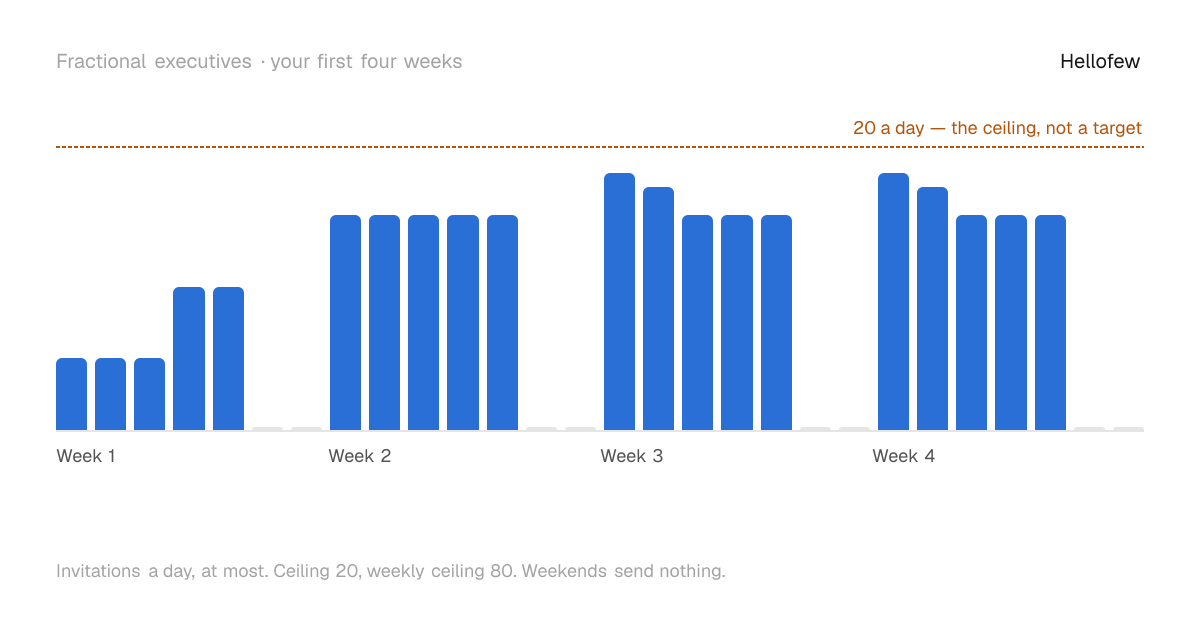
The agents work every weekday whether you are busy or not, so the pipeline fills while you are still delivering. Sending ramps from 5 a day over three weeks to a ceiling of 20, at irregular times inside your working hours — a steady pattern rather than a panic.
Your profile is your reputation, and your network is watching
A fractional exec lives on trust. Former clients check your profile before referring you. If they hear from a founder friend that you sent them a copy-paste pitch, that referral quietly never happens.
What happens instead
Each note is written from the recipient's own profile and posts, never merged from a template, and you read every one before it goes. Every quoted phrase is checked against what they actually wrote. A permanent do-not-contact list means anyone who asks never hears from you again.
The buyer is hard to find by title
You are not selling to "Head of Marketing" — the company needing a fractional CMO usually does not have one. You are selling to a founder or CEO at a certain stage, with a certain gap, and a job-title search does not know that.
What happens instead
The ICP is written from your own page and you can edit it: the titles, the stage, the angles. Every lead arrives with a fit score broken into its parts and the reason it was picked, and your skips are what show you where the targeting is off.
You cannot afford to lose the account that holds your network
Years of connections, recommendations and conversations live on that profile. A restriction does not cost you a channel; it cuts you off from the people who send you work.
What happens instead
Nothing sends from an account under 150 connections, the cap halves if acceptance drops, and inviting stops if it keeps dropping — before LinkedIn has to act. A flag in the first 24 hours stops sending until you restart it. That is materially safer than the category, not a guarantee; the limits are published so you can check them.
What your morning looks like instead
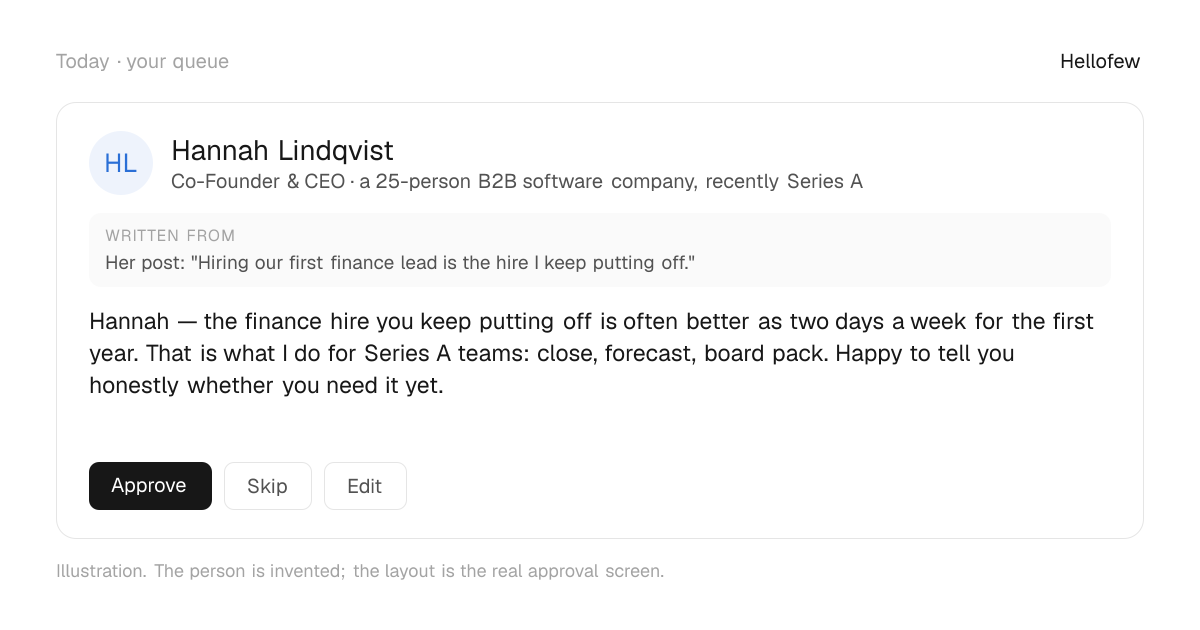
One card per person. Who they are, what the message was written from, and the message itself — so you can judge it in the three seconds you actually have. Approve, skip, or edit. Nothing goes out under your name that you have not read.
Who the agents would go looking for
Typical titles for this kind of buyer. Yours are written from your own page, and you edit them.
- Founder & CEO
- Co-Founder
- Managing Director
- President
- General Manager
- Chief Executive Officer
Your first month
- 1
Paste your services or about page. It writes an ICP — who needs you, five to eight titles, three angles, a sample note. Correct it; nobody knows your buyer like you do. Free, no card.
- 2
Subscribe at $49/month and connect LinkedIn on LinkedIn's own sign-in page. About a minute later: up to 25 people, each with a reason and a draft written from their profile.
- 3
Approve three and it starts, gently: 5 invitations a day, rising over three weeks towards 20. Nothing goes out that you have not read.
- 4
One follow-up at most. Replies land in one inbox and stop the queue for that person. By the time the current engagement ends, the next conversations are already open.
Who this is wrong for
If your work comes entirely through a placement firm or a platform, you do not need this. If you want to reach every Series A CEO in a country this month, the caps will frustrate you. And if you share one LinkedIn account with a partner or firm, it is not built for that — one account, one person.
Questions
Will my existing connections get messages?
It looks for new people matching your ICP. Anyone who asks not to be contacted is added to a permanent list, and anyone you skip is never messaged.
Can it write in my voice?
You edit the positioning and angles it writes from your page, and you can edit any draft before approving. What it will not do is sound like a template, because each note is written from the recipient's profile.
I sell several services. Can it handle that?
It works from one ICP at a time. If you sell two quite different things, pick the one you most want more of — a sharp ICP beats a broad one every time.
The first step costs nothing: paste your page and read what it writes about your market. If it gets your buyers wrong, you have learned something for free. $49/month when you connect LinkedIn and it starts finding real people.