For founders of boutique recruitment firms
Your recruiters are brilliant at finding candidates. Nobody is finding the next hiring manager, and the biggest client just froze headcount.
You built a specialist recruitment firm: one sector, one kind of role, a small team who actually understand what the candidates do. Clients who use you once come back, because you send three good CVs instead of thirty.
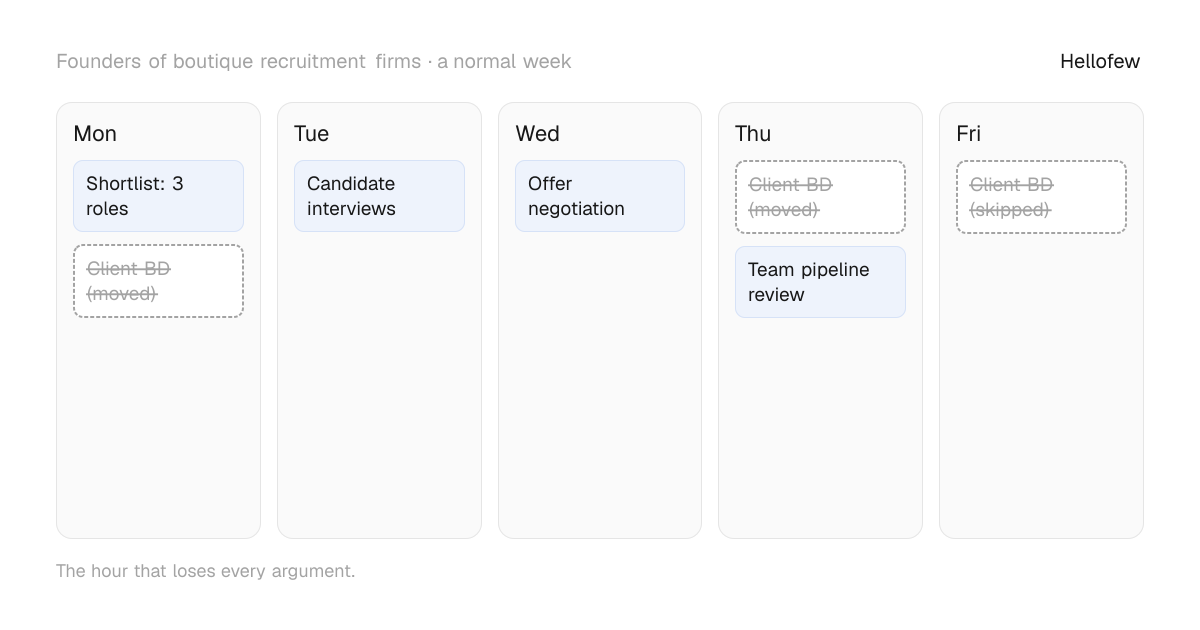
Client development is still on you, and it is the job with no hours in it. Your LinkedIn time goes to sourcing candidates, because that is what fills the roles you already have. Winning new clients is what you do when a big one freezes hiring — which is exactly when every other firm is doing the same.
Hiring managers know what a recruiter’s business development message looks like: “I have an exceptional candidate who would be perfect for your team.” They have received hundreds. They delete them on sight, and some of them block you.
So hand over the hour
Hellofew handles your client development separately from your sourcing, from your own account. You paste your firm’s page; agents find the hiring managers and heads of talent in your specialism, read what they post — about the roles they are struggling to fill — and write one honest note per person. You approve each one, and it sends while your team gets on with the desk.
What actually goes wrong
Business development only happens when a big client goes quiet
You meant to keep a steady stream of new client conversations. Then the desk got busy, and the stream stopped, and now one client’s hiring freeze is a quarter of your revenue.
What happens instead
The agents look for hiring managers every weekday, whether the desk is busy or not. Your part is a minute of approving in the morning.
Hiring managers have learned to ignore recruiters on sight
Unsolicited CVs, “exceptional candidate” teasers, agencies ringing the switchboard. Every hiring manager in your sector has a reflex for recruiter messages, and your firm is filtered with the rest.
What happens instead
The note is written from the person’s profile and posts, not from a candidate pitch. If they posted that a role has been open for four months, the note speaks to that — and any quote is checked character for character against what they wrote before it reaches you.
Your LinkedIn account is also your sourcing tool
A recruiter’s account being restricted is not an inconvenience; it is the tool the whole business runs on. You cannot risk it on something that fires off hundreds of invitations on top of your normal activity.
What happens instead
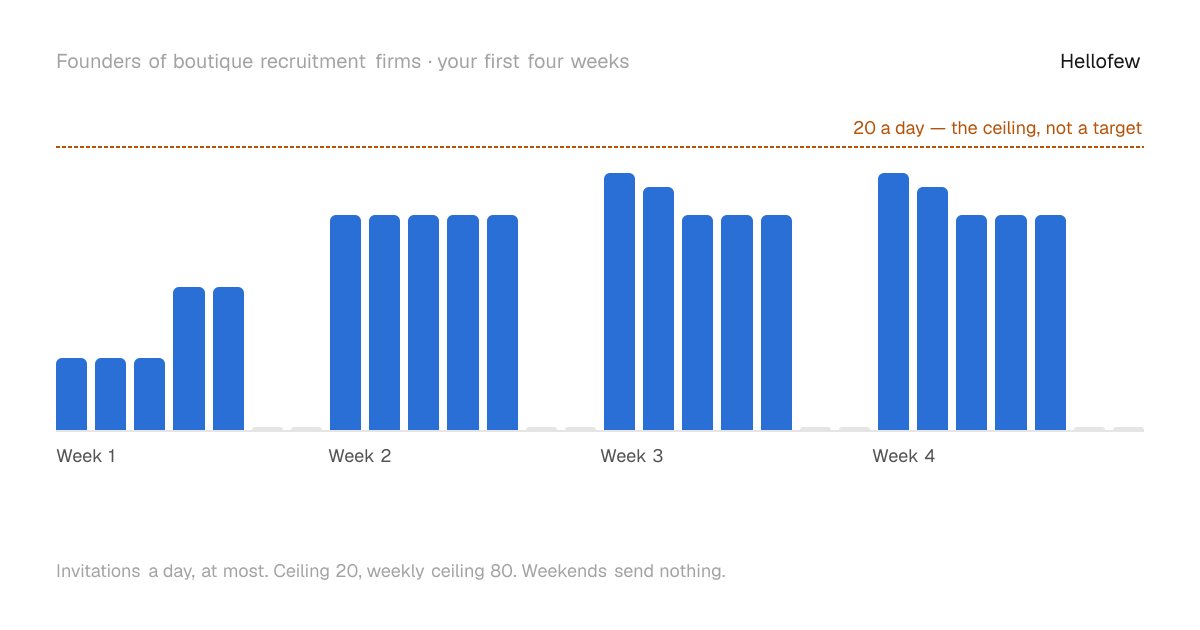
This is capped at 20 invitations a day and 80 a week, reached over three weeks, and it slows itself if acceptance falls. But be honest with yourself: your sourcing activity counts against the same account, and running another automation tool alongside breaks the limits entirely. Materially safer than the category, not immune.
Chasing is what makes recruiters unpopular
The third “just following up” to a hiring manager is how a firm ends up on a blocked list. In a niche sector, that list gets shared.
What happens instead
One follow-up, ever. Any reply cancels everything else queued for that person, checked twice up to the send, and anyone who asks not to be contacted is on a permanent list across every customer.
What your morning looks like instead
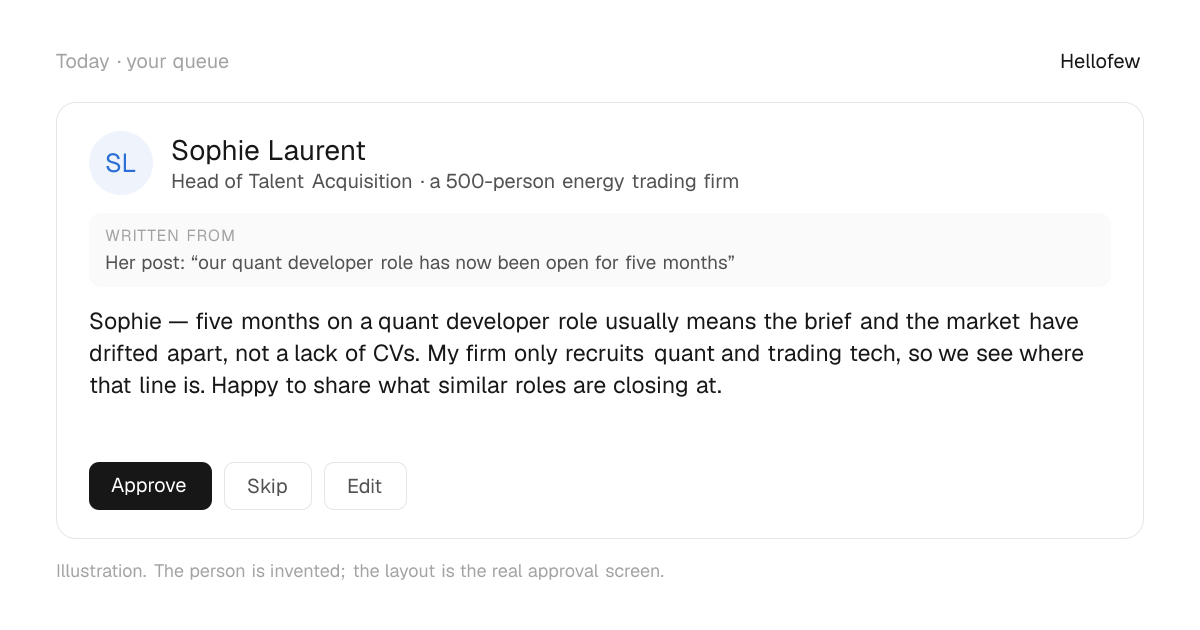
One card per person. Who they are, what the message was written from, and the message itself — so you can judge it in the three seconds you actually have. Approve, skip, or edit. Nothing goes out under your name that you have not read.
Who the agents would go looking for
Typical titles for this kind of buyer. Yours are written from your own page, and you edit them.
- Head of Talent Acquisition
- Talent Acquisition Manager
- Engineering Manager
- Head of People
- VP of Engineering
- Director of Finance
Your first month
- 1
Paste your firm’s page — free, no card. Make sure the ICP targets the hiring side of your specialism, not candidates; the titles decide everything.
- 2
Subscribe at $49/month and connect your LinkedIn. About a minute later there are up to 25 hiring managers and talent leaders in the queue, each with a reason.
- 3
Approve three and sending starts at 5 a day, climbing over three weeks towards 20, during working hours only, never at the edges of the day.
- 4
Accepted connections get one message and one follow-up at most. The Monday digest counts replies — the number that tells you whether new clients are on the way.
Who this is wrong for
This is not a candidate sourcing tool; if you want to message hundreds of candidates about roles, use LinkedIn Recruiter. If your firm runs every consultant’s client development through a CRM with activity targets, you need seats and integrations this does not have. And if your LinkedIn account already runs another automation tool or extension, do not connect it here — two tools on one account make every published limit meaningless.
Questions
Can I use it to message candidates?
It is built for client development: finding the people who hire, and writing to them. Candidate outreach at volume is a different job, and LinkedIn Recruiter is the right tool for it.
Will it clash with my own LinkedIn activity?
Your manual activity happens on the same account, so keep an eye on your own invitation habits. What must not run alongside it is another automation tool or browser extension; that is prohibited because we cannot see what it is doing.
Can each of my consultants have their own?
Each workspace runs one LinkedIn account for one person. It suits the founder’s own client development, not a team of consultants.
The first step costs nothing: paste your page and read what it writes about your market. If it gets your buyers wrong, you have learned something for free. $49/month when you connect LinkedIn and it starts finding real people.