For AI startups
Your buyer has been pitched forty AI tools this quarter. Yours is the one that actually works.
You built something real on top of a model — it saves an ops team a day a week, or reads contracts better than the junior who used to. The demo lands every time you get someone on a call. Getting someone on a call is the problem.
Because every inbox your buyer owns is full of the same pitch: "AI-powered", "10x", "agents that". Much of it is written by AI, and it reads like it. If your outreach sounds like theirs, it is filed with theirs. The irony is sharp: the AI company is the one that most needs its outbound not to sound generated.
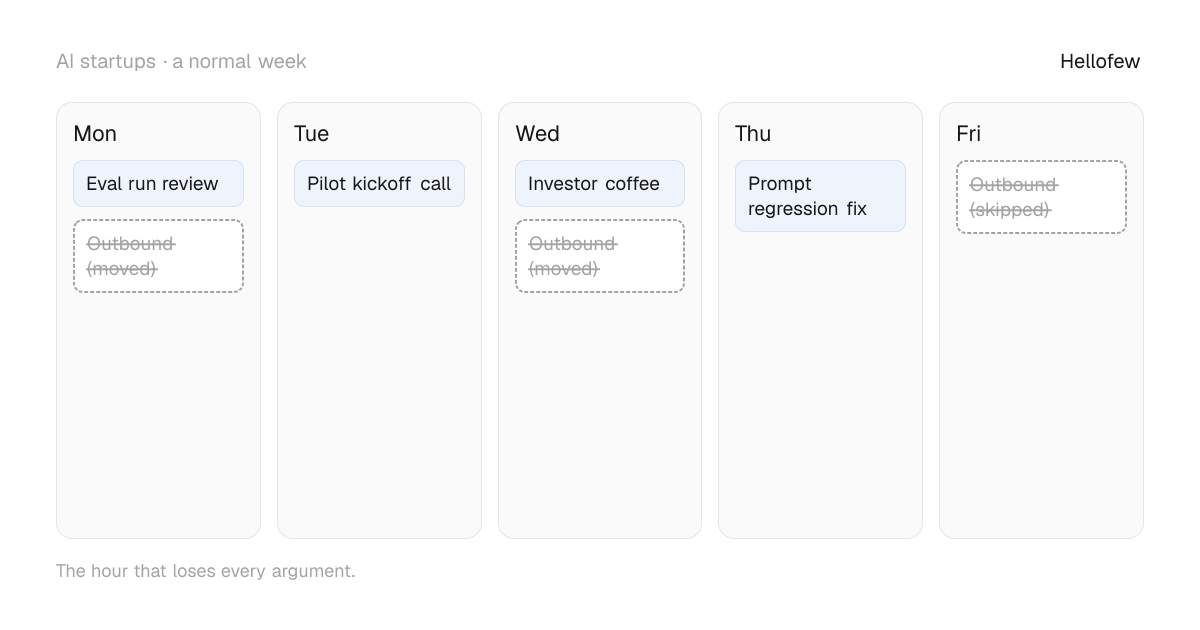
So hand over the hour
Hellofew is agents doing outbound, and the whole design is about not sounding like it. Paste your product page; agents work out who to talk to, find them, read each profile and recent post, and write one note per person grounded in what that person said. Any phrase it quotes is checked against their own words. You approve every message before it goes, from your own account.
What actually goes wrong
Your category is drowning in generated outreach
The head of operations you want to reach deleted six AI pitches this morning. All six opened with a compliment about their "impressive background". Whatever you send next is judged against those, in about a second.
What happens instead
Each note is written from the person's own profile and recent posts, not a template with a name merged in. Reposts are excluded, because thanking someone for an opinion they only forwarded is the fabrication people spot fastest. A draft too close to a recent one is thrown away and rewritten.
A hallucinated compliment would end the conversation — and your credibility
An AI company sending a note that misquotes the recipient is not an ordinary mistake. It is proof, delivered to the exact person you wanted to impress, that your product makes things up.
What happens instead
Every quoted phrase is compared, character for character, against what the person actually wrote. If it cannot be found, the quotation marks are stripped and the draft is flagged to you, so you see the problem before anyone else does. It is a string check, not a second model asked to mark its own homework.
Buyers want proof, and you are still finding your first ten
Early on, every conversation teaches you something: which title actually owns the problem, which angle gets a reply. Blasting a list burns through exactly the people you would have learned the most from.
What happens instead
Up to 25 people a day, each with a fit score you can take apart and the reason they were picked. Your skips and their replies are the signal. The ICP is a text box, not a black box — when a title is wrong, you change it, and the next queue follows.
Moving fast is how accounts get restricted
Fundraising momentum makes everything feel urgent, including a thousand invitations this week. Then the founder's profile — the one investors and hires check — gets restricted, right before the round.
What happens instead
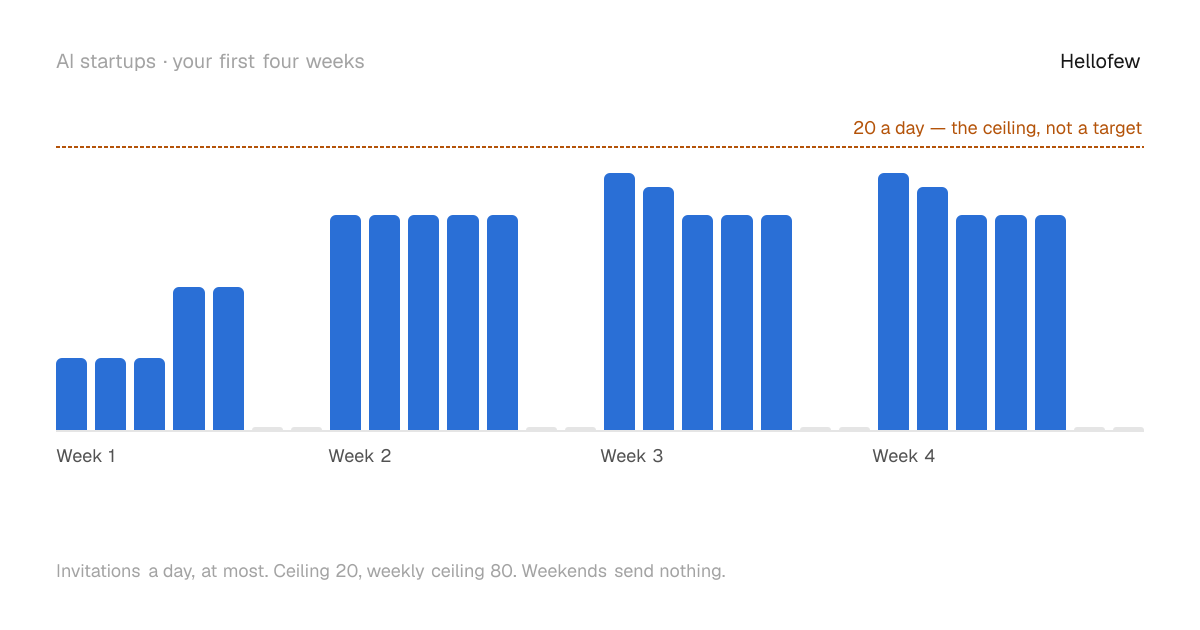
A ceiling of 20 invitations a day, reached over three weeks from 5. If acceptance falls, caps halve on their own; if it keeps falling, inviting stops and you are told. Nobody can promise an account will never be restricted, but these limits are published so you can check them.
What your morning looks like instead
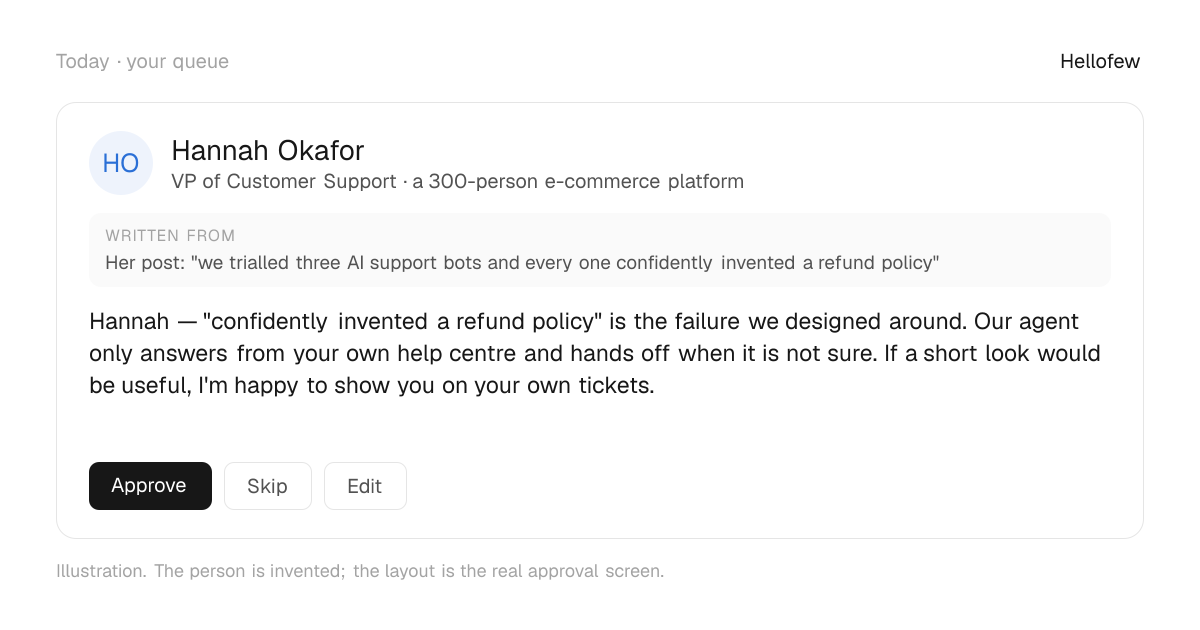
One card per person. Who they are, what the message was written from, and the message itself — so you can judge it in the three seconds you actually have. Approve, skip, or edit. Nothing goes out under your name that you have not read.
Who the agents would go looking for
Typical titles for this kind of buyer. Yours are written from your own page, and you edit them.
- Head of Operations
- VP of Customer Support
- Director of Legal Operations
- Head of AI
- Chief Operating Officer
- Head of Innovation
Your first month
- 1
Paste your product page and read the ICP it writes — free, no card. It is a good test of whether your page explains the value without the word "AI" doing all the work.
- 2
Subscribe at $49/month and connect LinkedIn. About a minute later, your first queue: up to 25 people, each with what the note was written from shown next to it.
- 3
Approve three and sending starts: 5 invitations a day, building over three weeks towards 20, weekdays only, inside your working hours.
- 4
One message to each person who accepts, one follow-up if they are quiet, and every reply in one inbox. Monday's digest tells you who replied — and why, if nobody did.
Who this is wrong for
If you are selling a consumer AI app, LinkedIn outbound is the wrong channel. If you want fully autonomous outreach with nobody reading the messages, this is deliberately not that — every note waits for your approval. And if you need email sequences alongside LinkedIn, buy a tool that does both; this is LinkedIn only.
Questions
Isn't using AI to sell AI a bit on the nose?
Only if it reads like it. The point here is that each note is grounded in something the recipient actually said, quotes are verified against their words, and you read every message before it goes. It is AI doing the research and the first draft, with a human deciding.
Can I control how it describes my product?
Yes. It writes the ICP — positioning, value proposition, three angles and a sample note — from your page, and all of it is editable. If it overclaims, fix it there and every draft after follows.
Will it help us find design partners rather than customers?
It finds people who match the titles you give it and writes to them from your angles. If your angle is "we are looking for three teams to build this with", that is what the notes will say.
The first step costs nothing: paste your page and read what it writes about your market. If it gets your buyers wrong, you have learned something for free. $49/month when you connect LinkedIn and it starts finding real people.