For consultancies
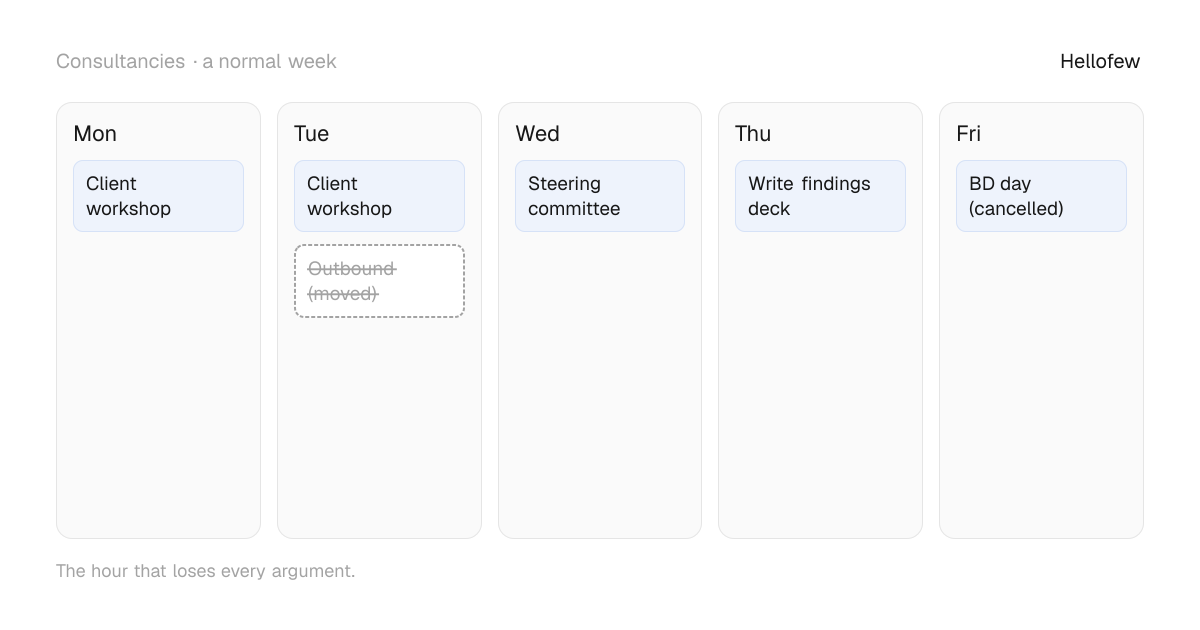
You are billable four days a week. The fifth day is supposed to be business development.
Your firm sells expertise. Engagements come from a partner's network, a former client who moved companies, a talk someone half-remembered. It works, and it is slow, and it depends almost entirely on who you happen to know this year.
Business development is meant to fill the gap, and it is the first thing a billable week eats. Worse, cold outreach feels beneath the work: a consultant pitching like a SaaS rep undermines the very authority you are selling. So you do not, and the network gets a little older every year.
So hand over the hour
Hellofew does the part you would rather not, in a way you would sign your name to. Paste your firm's site or a service page; agents turn it into the titles of the people who commission work like yours, find them, read each profile and recent post, and write one considered note per person. You approve each one. It sends from your account, follows up once, and stops as soon as they reply.
What actually goes wrong
The network is finite, and you have been drawing on it for years
Your best engagements came from people who already knew you. Every year, a few of them retire, change industry, or simply run out of problems you can solve. Nobody new is joining that circle unless you go and meet them.
What happens instead
The ICP names the five to eight titles that commission your kind of work, and up to 25 matching people arrive each day with a fit score you can take apart and the reason they were picked. It is a way to meet people you would have liked to know anyway.
A pushy message costs you the authority you are selling
A COO who gets "Quick 15 minutes to discuss your transformation journey?" files you with every vendor. A consultant is supposed to have noticed something. That is the job.
What happens instead
Each note starts from something the person actually said — a post about a stalled programme, a reorganisation, a new role. Quoted phrases are checked against their own words, and anything that cannot be found is stripped and flagged to you. One follow-up, ever. No "just circling back".
Billable weeks leave no room for rhythm
You intend to spend Friday on outreach. Then a client asks for a steering-committee deck by Monday. Business development happens in the gaps between engagements, which is exactly when you need it to have happened already.
What happens instead
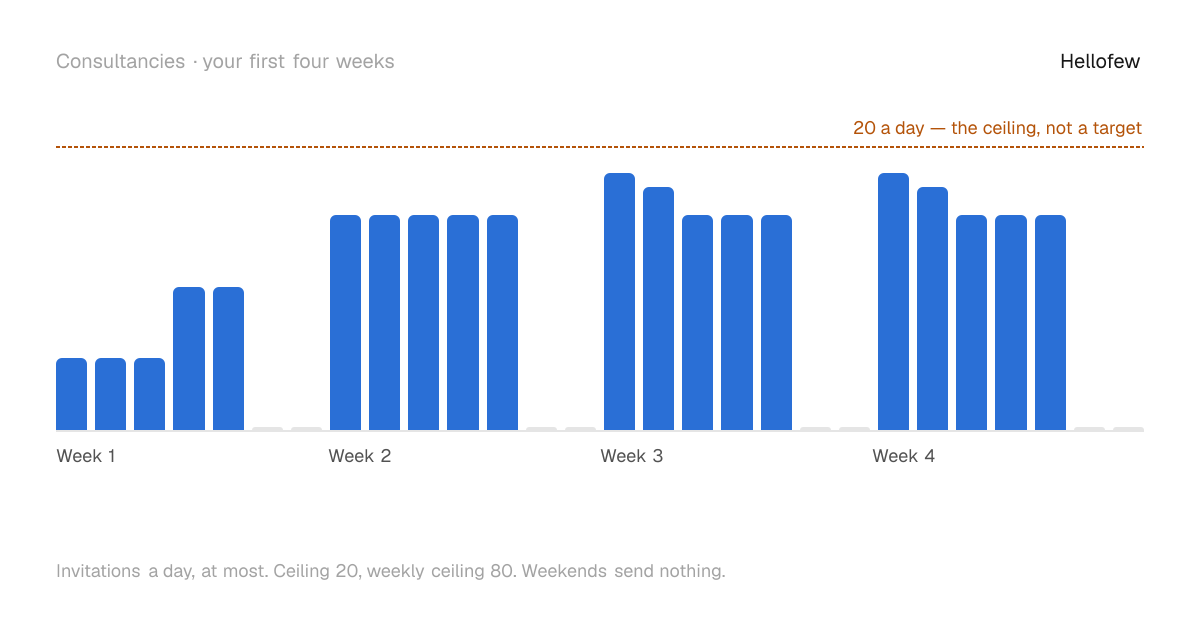
The agents work every weekday, inside your working hours, whether you are on-site or not. Your part is a minute of approving in the morning. The account ramps from 5 a day to a ceiling of 20 over three weeks, and stays there.
Your profile is your credential
Prospects vet you on LinkedIn before they answer: your history, your posts, who you know in common. It took fifteen years to build, and it is not the thing to gamble on a tool built to send as much as it can.
What happens instead
Nothing sends outside working hours or within twenty minutes of either end, weekends and public holidays are skipped, and a falling acceptance rate halves the caps and then stops inviting. Materially safer than the category, not risk-free — every limit is published so you can check it.
What your morning looks like instead
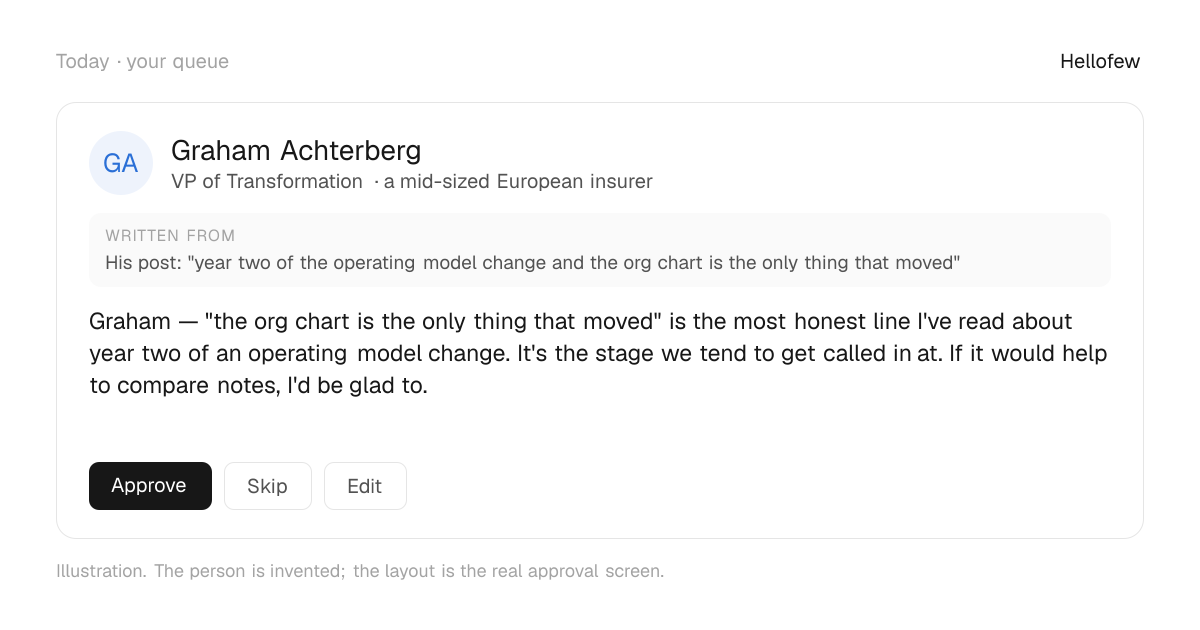
One card per person. Who they are, what the message was written from, and the message itself — so you can judge it in the three seconds you actually have. Approve, skip, or edit. Nothing goes out under your name that you have not read.
Who the agents would go looking for
Typical titles for this kind of buyer. Yours are written from your own page, and you edit them.
- Chief Operating Officer
- VP of Transformation
- Head of Strategy
- Director of Operations
- Chief People Officer
- Managing Director
Your first month
- 1
Paste your firm's site or a service page and read the ICP — free, no card. If the titles are wrong, that is usually a sign the page describes what you do rather than who you do it for.
- 2
Subscribe at $49/month and connect the LinkedIn account prospects will look up — usually the partner's. About a minute later, your first queue of up to 25 people, each note shown next to what it was written from.
- 3
Approve three and sending starts: 5 invitations a day, building over three weeks to a ceiling of 20, weekdays only, never at the edges of the day.
- 4
One message to each person who accepts, one follow-up if they are quiet. Replies arrive in one inbox, and Monday's digest says who replied — including when nobody did, and why.
Who this is wrong for
If your firm has a partner group that each wants their own outreach, this runs one account for one person and will not cover it. If your work is won only through formal tenders and procurement portals, LinkedIn outreach is unlikely to move it. And if you need a CRM record of every touch, there is no CRM sync.
Questions
Will the notes sound too salesy for our clients?
They are written from the recipient's own words and from your positioning, which you can edit. More importantly, you read every one before it sends. If a note would embarrass you, skip it or rewrite it.
Can it target a specific industry?
Yes. The ICP is a text box — name the industries, company sizes and titles you want, and the search follows it.
How many conversations should I expect?
I will not invent a number. The ceiling is 20 invitations a day; how many people reply depends on your offer and your positioning, not on this software.
The first step costs nothing: paste your page and read what it writes about your market. If it gets your buyers wrong, you have learned something for free. $49/month when you connect LinkedIn and it starts finding real people.