For technical founders of B2B SaaS
You can build the integration in an afternoon. The message to the person who would pay for it has been a draft for a month.
You are the one who wrote the thing. You know exactly which query is slow, which customer asked for the export, and why the pricing page says what it says. What you do not know is what to say to a stranger called Head of Operations that does not make you wince when you read it back.
So the pattern is familiar. A good week of shipping, then a guilty Sunday evening in LinkedIn search, twenty tabs of profiles, three half-written notes that all begin “Hi, I’m the founder of”, and nothing sent. The product gets better every week. The number of people who have heard of it does not move.
It is not that you cannot sell. It is that selling, done properly, is reading a profile carefully and writing one honest sentence to one person, and that task loses to a failing test every single time. There is always a failing test.
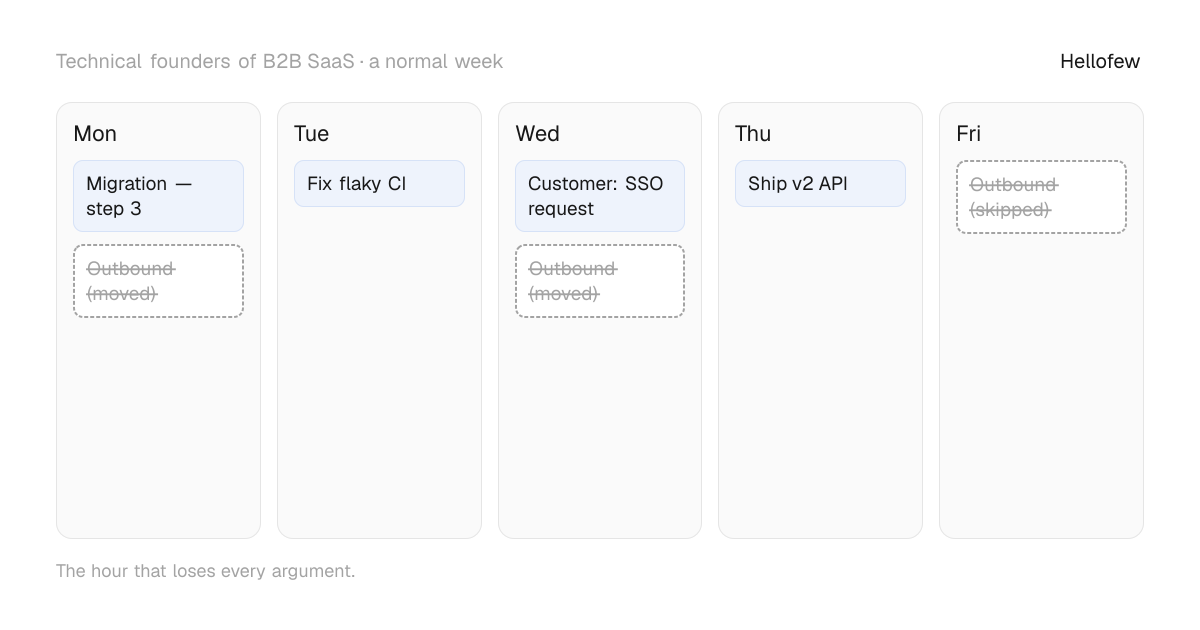
So hand over the hour
Hellofew takes that task off your hands without taking your name off it. You paste your product page; agents propose the job titles worth finding, find those people, read each profile and recent post, and write one note per person. You review the queue the way you review a pull request: approve, skip, or edit the line you would have written differently.
What actually goes wrong
Writing to strangers feels like a context switch you pay for all day
Twenty minutes on a cold note is not twenty minutes. It is the morning you were going to spend on the migration, broken into pieces, and a note at the end of it that still sounds like a template because you were thinking about the migration.
What happens instead
The writing happens before you open the queue. You read what was drafted and why, which is a review, not a blank page. Approving a batch takes about a minute, and that minute is the whole of your part.
You explain the product the way it is built, not the way it is bought
Your first instinct is to tell people it uses a queue and a diff engine, because that is the interesting part. The buyer does not care. They care that the Friday reconciliation stops. You know this, and you still write the architecture into every message.
What happens instead
The first thing the agents do is read your page and write the ICP back to you: five to eight job titles, the positioning, three angles, and a sample note. It is written from the buyer’s side of the table. You edit anything that is wrong, and you see your own product described in the words your customers would use.
A script would get this done faster, and a script would get the account restricted
You have thought about it. A headless browser, a list, a loop with a sleep in it. You also know what a platform sees when an account that was quiet for six months sends sixty invitations at exact intervals on a Tuesday night.
What happens instead
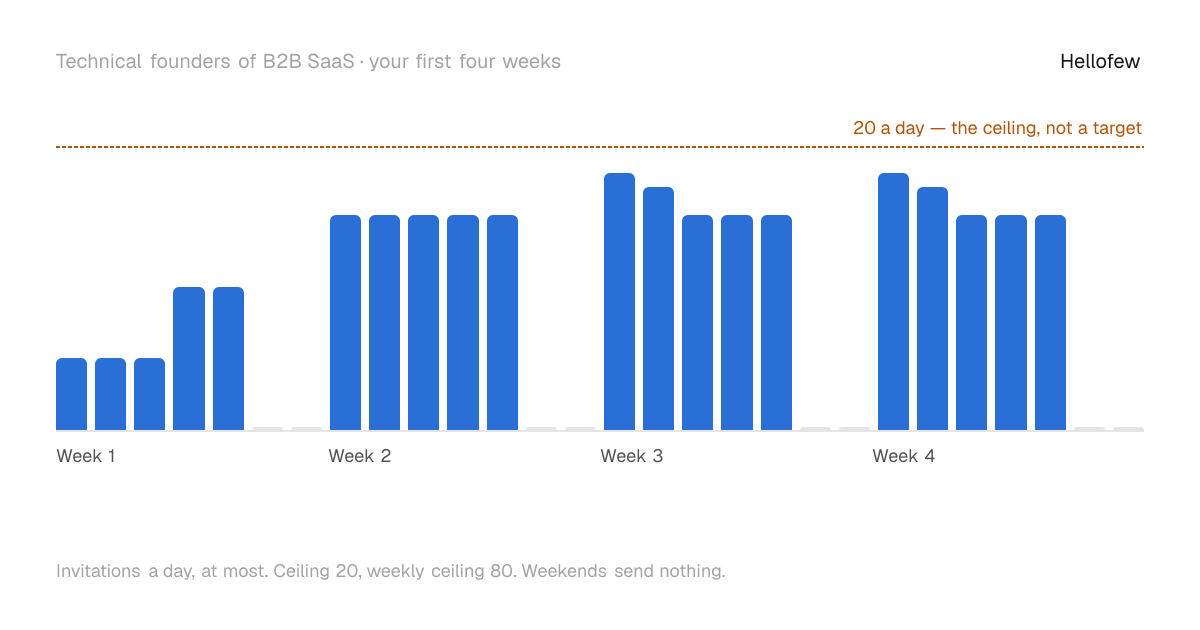
This is the loop, written by somebody who thought about that first. A new account starts at 5 invitations a day and ramps over three weeks to a ceiling of 20, with irregular gaps, only inside your working hours and never within twenty minutes of either end. The ceilings are constants in the source rather than settings, so there is no flag to flip at midnight.
Nobody hears about the release you worked hardest on
You shipped the feature three prospects asked for. The changelog has eleven readers. The prospects who asked for it were in a call six months ago and have forgotten your name.
What happens instead
Every note is written from the recipient’s own profile and recent posts, so the angle is their problem rather than your release. If someone wrote about the exact thing you just fixed, the note says so, and the quote is checked character for character against what they actually posted before it is allowed to reach you.
Replies arrive while you are heads-down, and you find them a week late
LinkedIn notifications are the first thing you mute when you are shipping. A buyer who said “sure, show me” on Wednesday hears back the following Thursday, by which time they have moved on.
What happens instead
Replies land in one inbox, and any reply cancels everything still queued for that person — checked twice, right up to the moment of sending — so nobody gets an automated follow-up after answering you. The Monday digest says who replied, so the week you were heads-down still ends with a list.
What your morning looks like instead
One card per person. Who they are, what the message was written from, and the message itself — so you can judge it in the three seconds you actually have. Approve, skip, or edit. Nothing goes out under your name that you have not read.
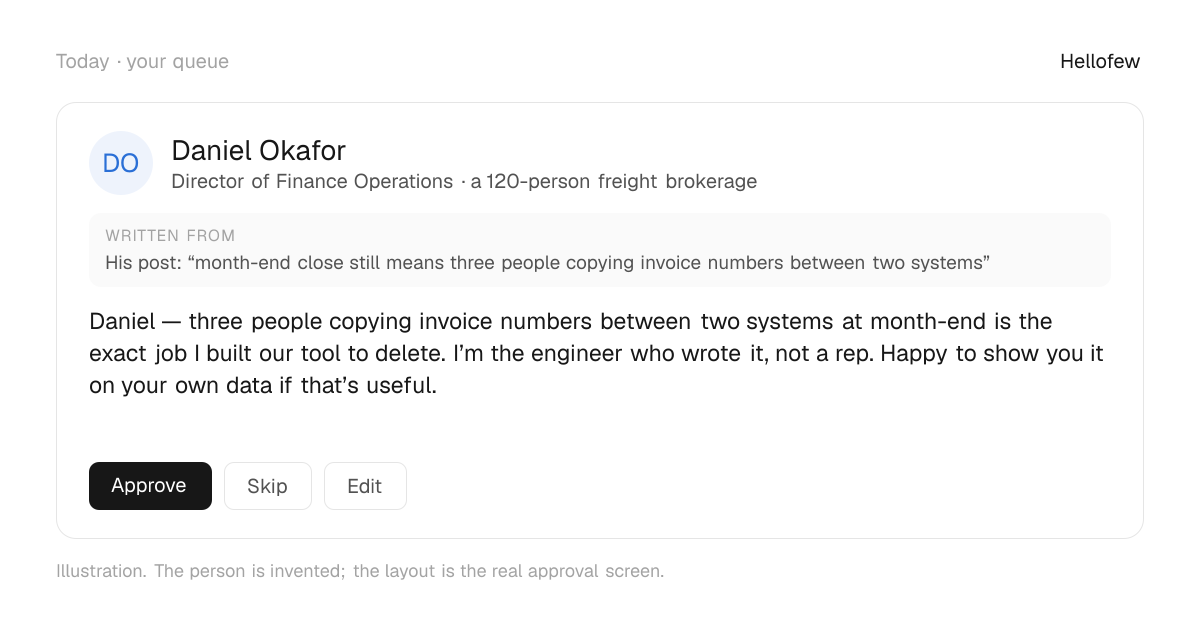
Who the agents would go looking for
Typical titles for this kind of buyer. Yours are written from your own page, and you edit them.
- Head of Operations
- Director of Finance Operations
- VP of Customer Success
- Head of RevOps
- Operations Manager
- COO
Your first month
- 1
Paste your product page — free, no card — and read the ICP it writes. If the titles are the users rather than the buyers, fix them now; it is the cheapest correction you will make all month.
- 2
Subscribe at $49/month and connect LinkedIn on LinkedIn’s own sign-in page. About a minute later there is a queue of up to 25 people, each with a fit score you can take apart and the reason they were picked.
- 3
Approve three and sending starts at 5 invitations a day, climbing over three weeks to 20. Skip anyone whose company you would not want as a customer; the skips teach you as much as the approvals.
- 4
People who accept get one message and at most one follow-up. On Monday the digest tells you how many replied. If nobody did, it says why — so you are debugging your targeting, not guessing.
Who this is wrong for
If your product is sold bottom-up to developers who never look at LinkedIn, this is the wrong channel and you should spend the hour on docs and a launch post instead. If you have raised a round and are hiring an SDR team next quarter, you want a tool with seats and a CRM sync; this runs one account for one person. And if you would never read a draft before it goes out, do not buy it — approving each message is not optional.
Questions
Can I just edit the prompt instead of approving messages?
No. You edit the ICP, the positioning and the angles, which is where the instructions live, and then every message waits for you. Approval is the only way anything sends, and it cannot be switched off.
Does it expose an API or a CSV export of leads?
No. It is one loop for one account — search, read, write, send, reply — and it is not a lead database. If you want raw lists to feed your own tooling, a data provider is the better purchase.
Will prospects know it was drafted by software?
They will see a note from you, from your account, that refers to something they actually wrote, and nothing is sent that you have not read. A draft too similar to a recent one is discarded and rewritten, so nobody receives the same note with their name swapped in.
Is it safe to run on my own profile?
Safer than anything else in the category, not risk-free. LinkedIn’s terms prohibit automation and nobody can promise an account will never be restricted. What you get is a hard ceiling of 20 a day, a three-week ramp, and automatic slow-downs when acceptance falls, all published.
The first step costs nothing: paste your page and read what it writes about your market. If it gets your buyers wrong, you have learned something for free. $49/month when you connect LinkedIn and it starts finding real people.