For freelancers
The project ends Friday. You spent the last six weeks doing the work instead of finding the next one.
You are a developer, designer or writer who works for businesses. The work is the part you are good at and the part you enjoy. Finding it is the part that decides whether next month pays the rent.
Freelance platforms race you to the bottom on price. Your network is generous but finite. LinkedIn is where the people who hire freelancers directly actually are — but reaching out properly takes time you only have when you are not being paid, and mass-messaging tools make you look like one more agency spamming founders.
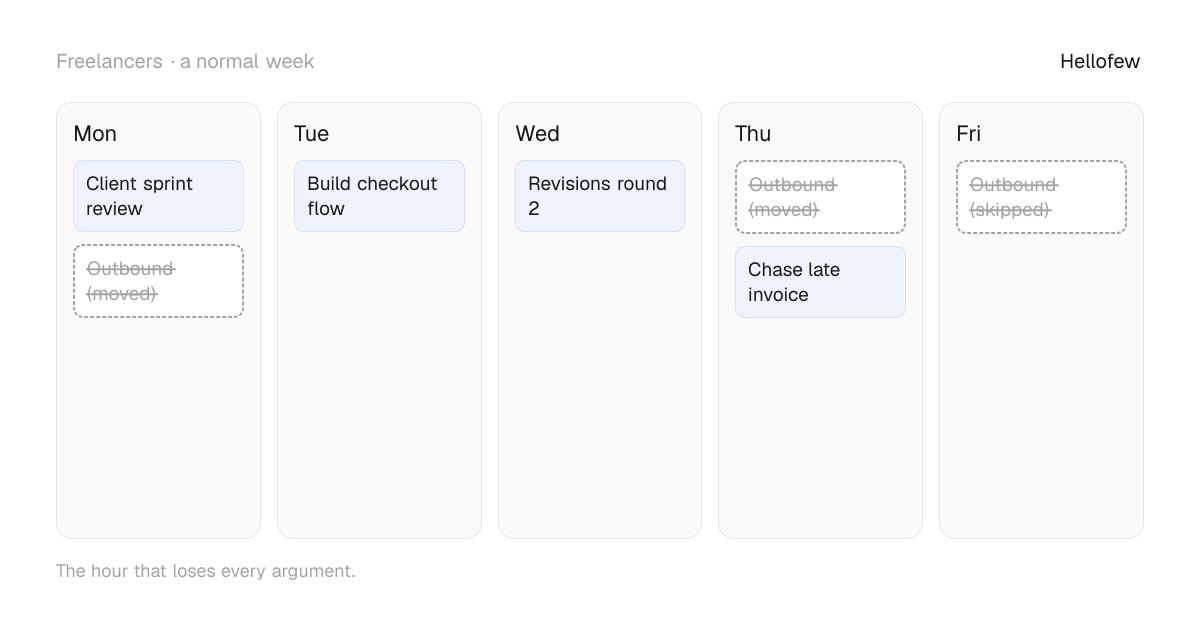
So hand over the hour
Hellofew keeps outreach going while you are heads-down on client work. You paste your portfolio or services page; agents work out who hires people like you, find them, read their profile and write one note each. You approve the queue in a few minutes. It sends from your account at a careful pace, follows up once, and stops the moment someone replies.
What actually goes wrong
You only look for work when you have none
While a project runs, you are delivering. When it ends, you start prospecting from zero, and the gap between the last invoice and the next one is the part of freelancing nobody talks about.
What happens instead
The agents search, read and write every weekday, so conversations are already open when a project wraps. Your part is approving the morning queue — minutes, not an afternoon.
Your pitch sounds like every other freelancer's
"Hi, I'm a freelance designer with ten years of experience…" The founder reading it has had five of those this week. What would stand out is something that shows you actually looked at their product.
What happens instead
Each note is written from the person's own profile and recent posts — what they are building, what they said is broken. Every quote is checked verbatim against their words, and a draft too similar to a recent one is rewritten.
You are your own brand, and one bad message travels
Clients hire freelancers on trust. If a founder shares your copy-paste message in a Slack community as an example of what not to do, that community is where your next three clients were.
What happens instead
Nothing sends that you did not read and approve. One follow-up, ever. Anyone who asks not to be contacted goes on a permanent do-not-contact list, across every customer, that is never deleted.
You cannot risk the account your portfolio lives on
Your recommendations, your case studies, your whole professional history is on that profile. It is the first thing a prospect checks after a platform profile.
What happens instead
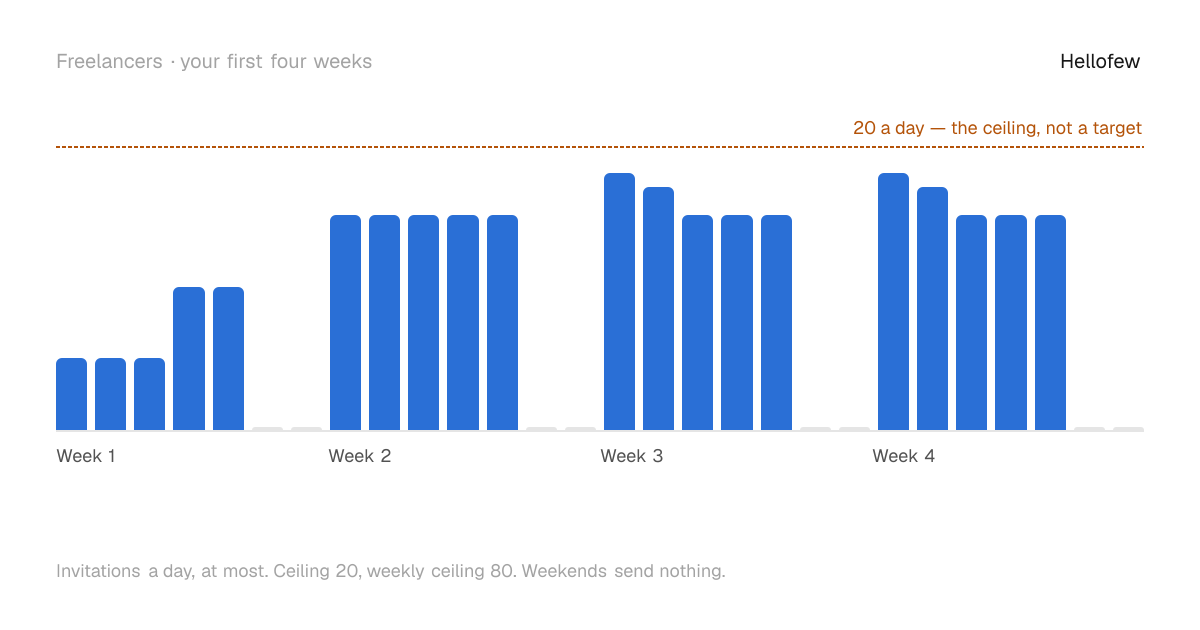
Sending starts at 5 invitations a day and climbs over three weeks to a ceiling of 20. Below 150 connections it sends nothing, because that is the pattern LinkedIn restricts most. Safer than the category by design, with every limit published — never a promise that nothing can go wrong.
What your morning looks like instead
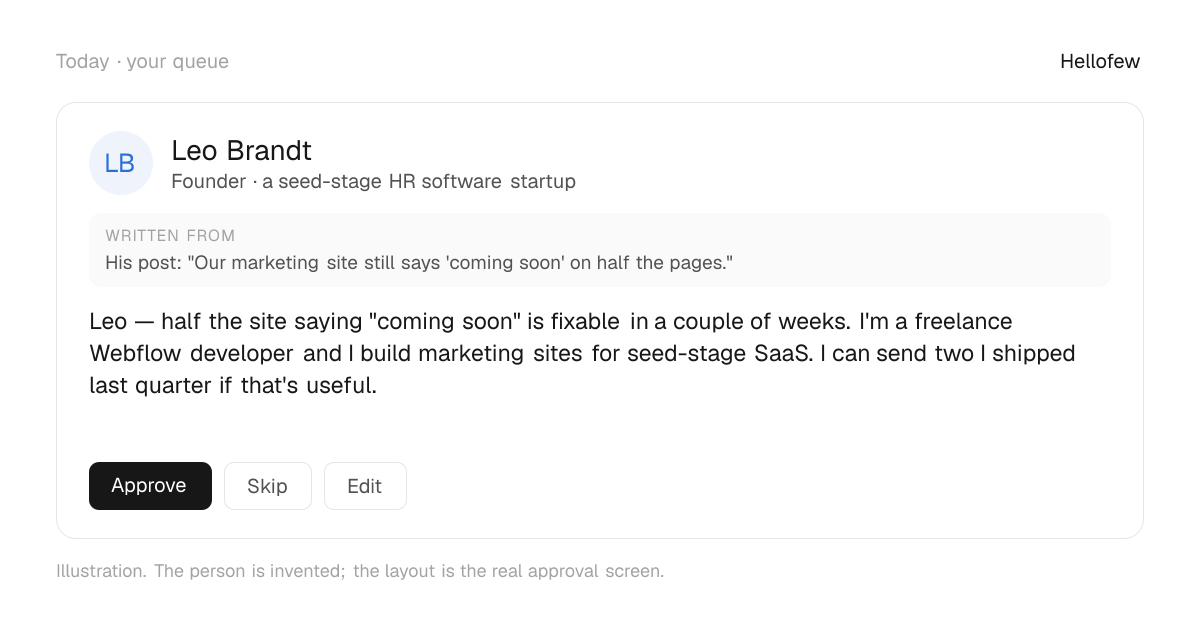
One card per person. Who they are, what the message was written from, and the message itself — so you can judge it in the three seconds you actually have. Approve, skip, or edit. Nothing goes out under your name that you have not read.
Who the agents would go looking for
Typical titles for this kind of buyer. Yours are written from your own page, and you edit them.
- Founder
- Head of Product
- Marketing Director
- CTO
- Head of Content
- Product Manager
Your first month
- 1
Paste your portfolio or services page and read the ICP: who hires you, five to eight titles, three angles. Correct anything. Free, no card.
- 2
Subscribe at $49/month and connect LinkedIn on its own sign-in page. About a minute later, up to 25 people appear, each with a draft written from their profile.
- 3
Approve three and it starts: 5 invitations a day, rising over three weeks towards 20, inside your working hours only.
- 4
One follow-up at most. Replies land in one inbox and cancel the queue for that person. The Monday digest tells you how many replied.
Who this is wrong for
If your clients are consumers or small local businesses who are not on LinkedIn, this is the wrong channel. If you mainly win work through platform bidding, it will not replace that. And if you want to message hundreds of startups a week, the caps will not allow it.
Questions
Can I use it between projects only?
Yes. Nothing sends without approval, and you can cancel any time — the queue stops the same day and there is no contract. Keeping it running during projects is what closes the gap, though.
Does it attach my portfolio?
Messages are text, as LinkedIn messages are. The ICP it writes from your page shapes the angle; you can edit any draft to add a link before approving.
What about a free LinkedIn account?
It works, with less headroom. Free accounts invite without a note and get a personalised message after acceptance, with a weekly ceiling of 50 rather than 80.
The first step costs nothing: paste your page and read what it writes about your market. If it gets your buyers wrong, you have learned something for free. $49/month when you connect LinkedIn and it starts finding real people.