For technical founders
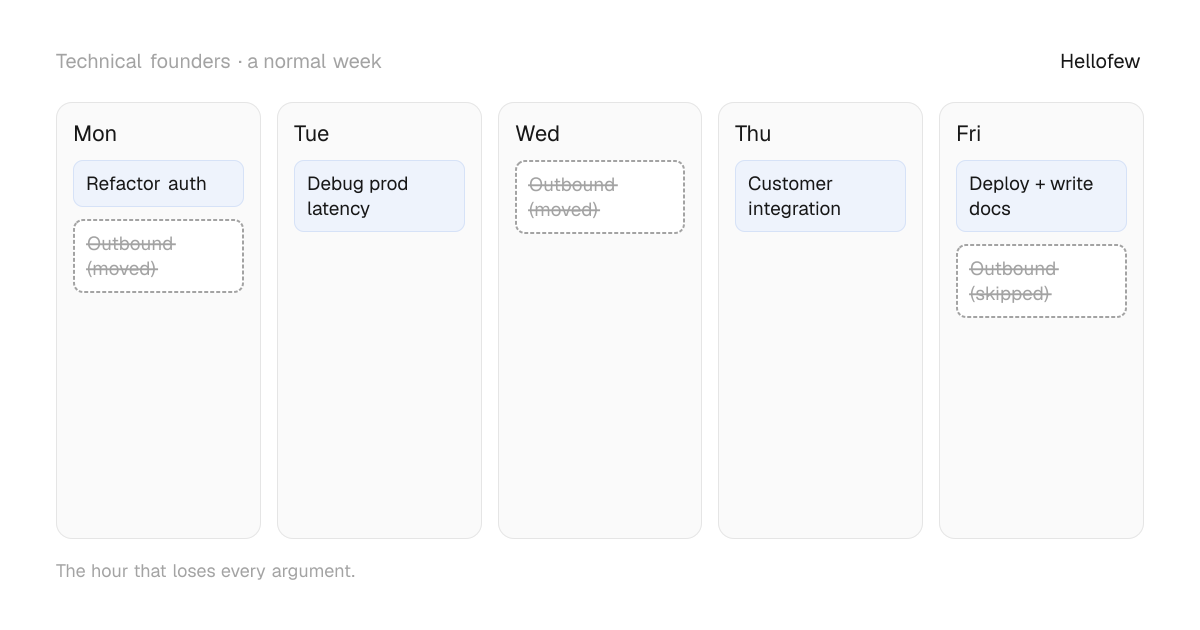
You can build the whole product in a weekend. Writing one cold message takes you forty minutes and you still hate it.
You built something that works. You can explain, in detail, why it is better than the alternatives. You can even name the kind of company that needs it. What you cannot do is open LinkedIn, find a stranger, and write three sentences to them that do not make you wince.
So you do what engineers do: you avoid it, then try to automate it. And every automation you look at is a template engine with a mail-merge field for the first name, pointed at your account at whatever volume you are willing to risk. You know exactly what that produces, because you delete dozens of them a week.
So hand over the hour
Hellofew does the part you hate, and does it the way you would if you had the patience. You paste your product page; agents turn it into specific job titles, find those people, read their profile and recent posts, and write one note per person from what is actually there. You read the queue, skip anything that sounds wrong, and approve the rest. It sends from your account and stops the moment someone replies.
What actually goes wrong
You write feature lists when the buyer wants to hear about their problem
Your first draft always opens with what the product does, because that is what you know best. The reader does not care yet. They care about the thing in their week that is annoying them, and you do not know what it is because you have not read their profile properly.
What happens instead
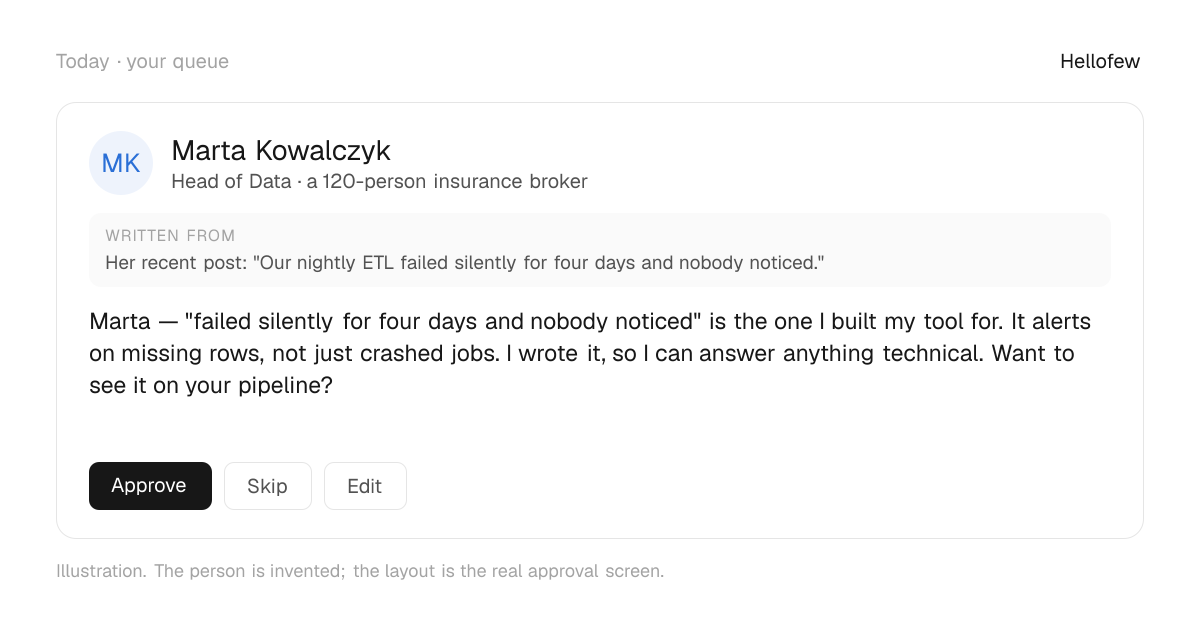
Before anything is written, the person's profile and recent posts are read. The note opens on what they said or do, not on your feature list — and the ICP it works from includes three angles written from your product page, which you can edit like any other text.
You do not trust software to write in your name
You have seen what language models do when they are asked to be personal: they invent. A compliment on a post the person never wrote. A reference to a talk they did not give. The one person who can catch that is the stranger you are trying to impress.
What happens instead
Every quoted phrase in a draft is checked, character for character, against what the person actually wrote. Reposts are excluded, so you never praise someone for words they only forwarded. A quote that cannot be found is stripped and the draft is flagged to you. And nothing sends until you approve it.
You want to see the logic, not a black box
A tool that says "94% match" and nothing else is asking for trust it has not earned. You would like to know why a person was picked, and what the thing will do tomorrow before it does it.
What happens instead
Every lead carries a fit score broken into its parts and the reason it was picked. The sending schedule — who, at what time, under which cap — is visible before it runs. The limits are constants in the source, published in full.
You would rather fix the rate limit than get your account flagged
You think about systems in terms of limits and back-off. Most outreach tools do not: they give you a volume slider, and the only feedback loop is LinkedIn restricting you.
What happens instead
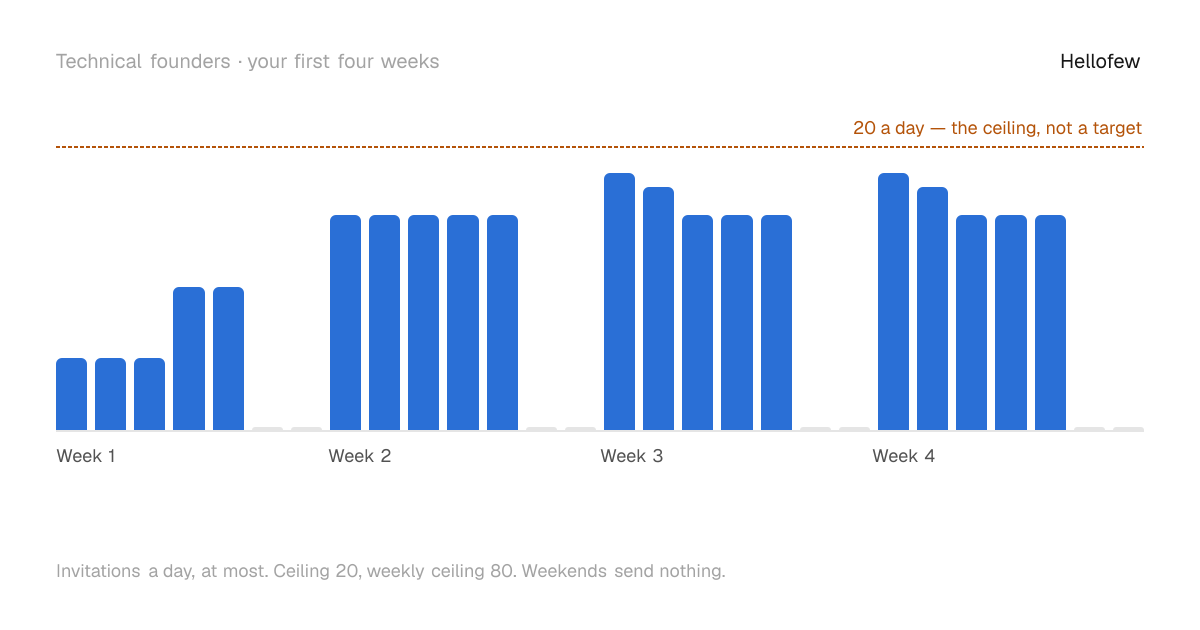
The ceiling is 20 invitations a day and 80 a week, ramping from 5 over three weeks. Acceptance rate is watched like an error rate: below threshold the cap halves, further below it inviting stops, and a blunter check runs from day four. A LinkedIn flag in the first 24 hours stops the account until you restart it. None of that makes an account unbannable; it makes it much harder to get there by accident.
What your morning looks like instead
One card per person. Who they are, what the message was written from, and the message itself — so you can judge it in the three seconds you actually have. Approve, skip, or edit. Nothing goes out under your name that you have not read.
Who the agents would go looking for
Typical titles for this kind of buyer. Yours are written from your own page, and you edit them.
- VP of Engineering
- Head of Platform
- Director of Operations
- CTO
- Head of Data
- Engineering Manager
Your first month
- 1
Paste your product page and read the ICP: five to eight job titles, three angles, a sample note. Edit the angles in your own words if they read too salesy — it is a text box, not a black box. Free, no card.
- 2
Subscribe at $49/month and connect LinkedIn through LinkedIn's own sign-in page. Your password and 2FA code never reach us. About a minute later: up to 25 people with a score breakdown and a draft each.
- 3
Approve three and sending starts, at 5 invitations a day, rising over three weeks towards 20. The schedule is visible before it runs.
- 4
People who accept get one message and one follow-up at most. Replies land in one inbox and cancel the queue for that person. On Monday the digest reports replies and, on quiet weeks, the reason.
Who this is wrong for
If you want an API, webhooks and a CRM sync to wire into your own stack, this is not that — it runs one LinkedIn account with no integrations. If your buyer is a developer who lives on GitHub rather than LinkedIn, the channel is probably wrong. And if you want to tune volume upwards, you cannot: the caps are constants.
Questions
Can I edit the prompts or the messages?
You edit the ICP — titles, positioning, angles — and you can edit any individual draft before approving it. There is no prompt console; the inputs that matter are the ICP and your approvals.
How do you connect to LinkedIn?
Through Unipile. You sign in on LinkedIn's own page; we hold an opaque account id, never your password. The session is pinned to one address in the country you choose.
Why can I not raise the limits?
Because the failure mode of a raisable limit is that somebody raises it. The caps are constants in the source, set well below what the category runs, so a bad week cannot talk either of us into spending your account.
The first step costs nothing: paste your page and read what it writes about your market. If it gets your buyers wrong, you have learned something for free. $49/month when you connect LinkedIn and it starts finding real people.